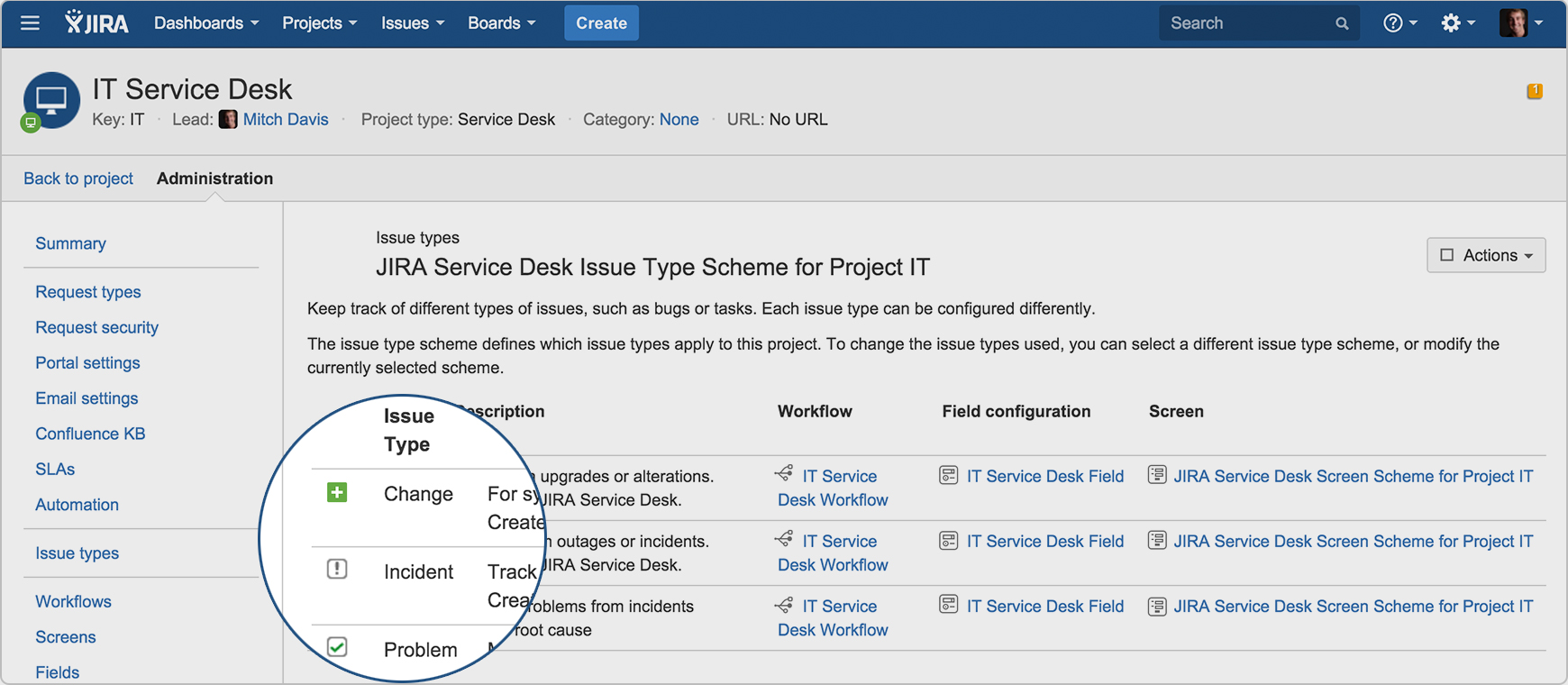
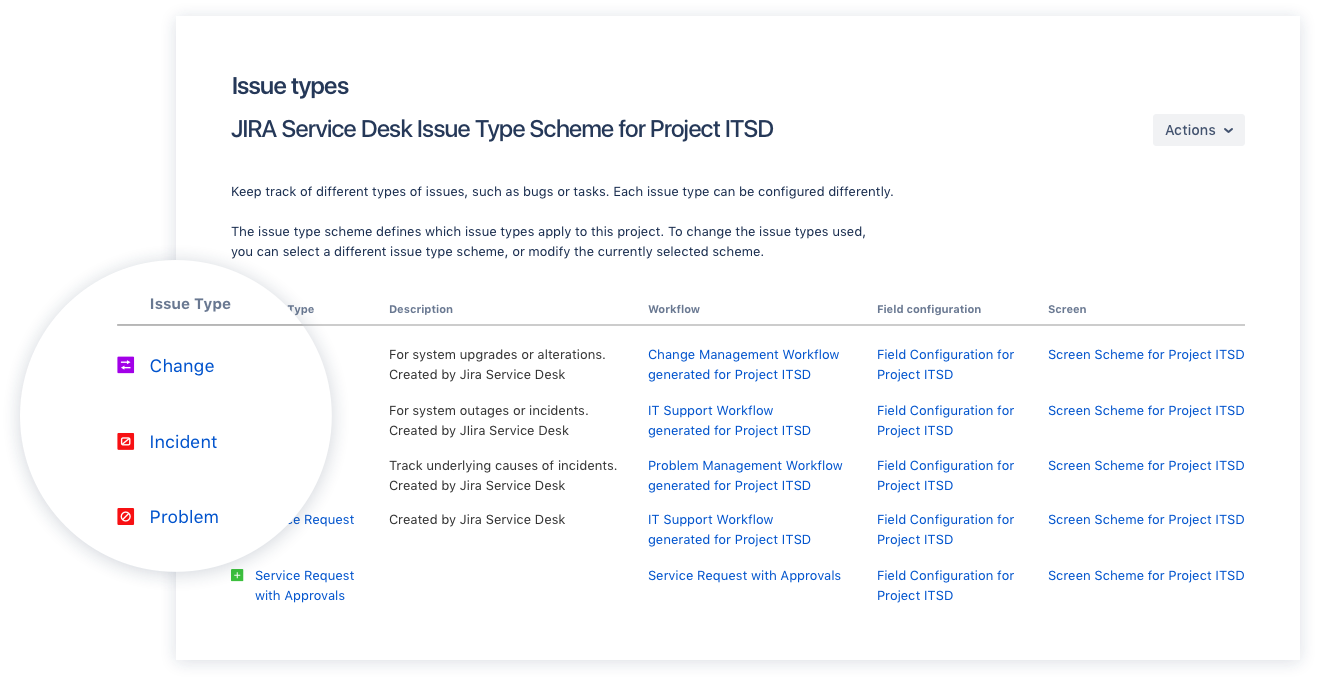
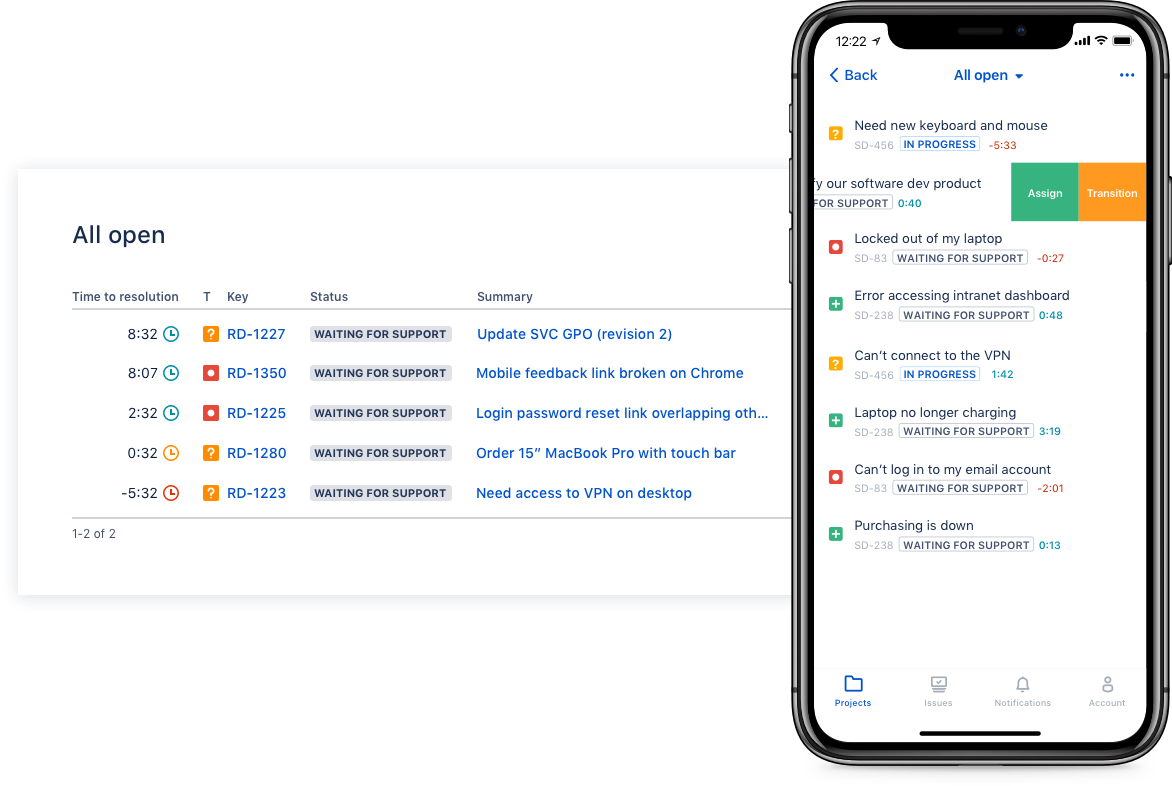
Jira Service Management (formerly Jira Service Desk, now including features from the former Mindville Insight, acquired by Atlassian in June 2020) is a service desk software that is purpose-built for IT, service, and support teams. The software provides everything IT and support teams need out-of-the-box for service request, incident, problem and change management. Jira Service Management integrates seamlessly with Jira Software so that IT and development teams can work better together. Users…
$0
per month
ServiceNow IT Service Management
Score 8.2 out of 10
N/A
Built on the ServiceNow Now Platform, the IT Service Management bundle provides an agent workspace with knowledge management, and modules supporting issue tracking and problem resolution, change, release and configuration management.
N/A
Zendesk Suite
Score 8.6 out of 10
N/A
Zendesk is a customer support solution with built-in ticketing, conversational messaging, and live chat, designed to help businesses of all sizes and industries deliver personalized service at scale. Zendesk's AI agents are trained in CX to help Service teams resolve customer issues faster and more accurately while still providing a human-centered experience. Zendesk ultimately aims to help businesses improve time to value, reduce effort per ticket, and keep costs low.
$69
per month per agent
Pricing
Jira Service Management
ServiceNow IT Service Management
Zendesk Suite
Editions & Modules
Free
$0
per month
Standard
$20
per agent/per month
Premium
$40
per agent/per month
Enterprise
Contact sales team
ITSM Standard
Custom Quote
ITSM Pro
Custom Quote
ITSM Enterprise
Custom Quote
Suite Team
$69
per month per agent
Suite Growth
$115
per month per agent
Suite Professional
$149
per month per agent
Suite Enterprise
Contact Sales
Offerings
Pricing Offerings
Jira Service Management
ServiceNow IT Service Management
Zendesk Suite
Free Trial
Yes
No
Yes
Free/Freemium Version
No
No
No
Premium Consulting/Integration Services
Yes
No
Yes
Entry-level Setup Fee
No setup fee
No setup fee
Optional
Additional Details
—
ITSM Pro and ITSM Enterprise also are available with optional "Plus" add-ons. These include AI Agents, an AI Agent Studio, and other features that augment the capabilities of the platform using AI Virtual Agents to automate tasks.
JSM is more purpose-built for internal support tickets and processes. It also provides a structure to support users, unlike generalist tools like Notion. We found that there isn't really an 'all-in-one' tool that can correctly handle internal and external requests. This isn't …
We chose Jira Service Management due to its easy integrations with the rest of the Atlassian tools, as we have also invested in those. For the price, the ability to add or remove agents, and the cost being reflected in that, it was an excellent medium for us. For the …
It was the most complete package, requiring the lesser adjustments compared to the others, had the most options to tailor to our specific needs, and the price for the Cloud hosted version was fair.
We selected Jira Service Desk because we were already Jira users, and the price point was easy to absorb. Our experience as Jira administrators made it easy to customize Jira Service Desk to our needs.
Unlike the 2 other alternatives, Jira is more complete. It is a bit harder to use, but because it has more customized and better functionalities. While other software can be used for almost everything, Jira works best for tech companies that need to work on agile methodologies …
Jira SD is between Tivoli and Service Now. In this particular case, we are using JIRA SD as the customer asked us to integrate some things with products he already had, such as Confluence, where he kept all the information we could use.
ServiceNow has many of the same features of JIRA. Teams within the organization use both ServiceNow and JIRA, but we primarily use JIRA. We chose JIRA because it seemed easier to set up the linking of related tasks and projects together, but other teams have said the same thing …
We are now in the process of moving from Jira to Zendesk, however, I would assume that we would still be using Jira for the time being. Zendesk is a bit easier to understand and manage for the non-technical people, but Jira gave us the basics that we needed to have in order to …
Zendesk is a similar ticketing system that our organization used before JIRA Service Desk. The main drawback of Zendesk was that it can only be used as a cloud service. This means that our company data would be living on the internet at the hands of their security team. Another …
Sure there are other great service management products in the market. Since we use JIRA and Confluence heavily, Service Desk fits perfectly in the suite. As a brief example, after the customer creates a case, we can create an associated issue at JIRA for development team, after …
Very cost effective and you receive full service help desk software system and network monitor all-inclusive. It is capable of productivity and easy to maintain. It is a easy to use help desk solution that includes a ticketing system, inventory system and a network monitor. …
It really is not established above other tools of the market, it is quite similar to its similar ones in the market. JIRA is used depending on multiple factors such as cost and size of the organization but I do not see a real competitive advantage with respect to other similar …
We have looked into other software and still use the others like Zendesk and Wrike in other departments but Jira Service desk made the most sense due to our Product development teams using Jira Software already. It was easy to keep it all under one umbrella giving us the ease …
ServiceNow IT Service Management is suitable for 10,000+ employee enterprises requiring cross-functional service management. JSM is effective for smaller teams, often in the 1,000-10,000 employee range. But we selected ServiceNow IT Service Management because it excels in …
ServiceNow offers a robust CMDB than other market alternatives, that is our key parameter as the organization complexity requires a detailed CMDB setup to minimaze impact of frequent changes that are being executed. A unified platform that can scale with our complex global …
Our Company uses Service now for a long time. I have seen the evolution and honestly the product has recently surprised me. The improvements have been incredible in terms of speed and ease of use. My team is very happy with the product. The interaction has improved remarkably …
Verified User
Technician
Chose ServiceNow IT Service Management
The IT Asset Management tool that is included and the way you connect that to your support portal is one of the things where ServiceNow is stacking up against Jira or TOPdesk for example. The features are unlimited and that is why we prefer this tool.
Verified User
Consultant
Chose ServiceNow IT Service Management
ServiceNow feels like a more robust and polished product the creation of workflows and flexibility to customize is better than with the rest of the applications, it is also easier to integrate with external applications as these 'connections' are regularly updated to …
We looked into a few different tools. We POC'ed Jira, and while it did a lot of things well, it didn't meet our needs. ServiceNow has a lot of different features that were attractive to our firm and ultimately, we decided the extra cost was well worth it. Zendesk was another …
Originally designed for software bug tracking, JIRA is much easier to use than ServiceNow. It lacks the CMDB power of ServiceNow, but can be adapted for not only ticketing, but change management as well. I worked with both SerivceNow at my previous employer who tossed it in …
Both platforms were very well tested, widely used solutions for managing enterprise IT services in the industry. ServiceNow was the more future-proof of the two, giving our organization more value by integrating into the tools we already have. Remedy remains a monolithic …
Other products did not have the needed functions. Pricing was also very advantageous with ServiceNow. The industry needs in this area are constantly evolving, so it is important to choose a tool that allows for the integration, workflows, and customer experience required. …
ServiceNow seems to be able to scale as large as you would like it to and outpaces the competition as far as ease of licenses and growth. While it is clunky it really allows you to drill down to the smallest workflow or permissions to really allow the system to build around …
Task management is easy in ServiceNow compared to JIRA, Freshdesk, and other tools. Asset management and change management is easy in ServiceNow. Community support is the major advantage for ServiceNow. The API and extensibility of ServiceNow are very high. Considering …
We previously had our Change management process in Sharepoint which was cumbersome and very manual. Bringing this process into ServiceNow was one of the best things we could have done. With Zendesk, we decided to use that system for another department and it just doesn't …
ServiceNow is a platform for service management, this is the big separator between the competitors. It is not simply an ITSM tool, and most organizations need a single pane of glass. This allows for all service management to live in one tool, which is the nirvana that most …
Here are the explanations for my preference of analysis Zendesk Suite to this end:
Power + Usability: Zendesk Suite has abundant omnichannel coverage, acceptable automation, and decent reporting but does not go all in to full-custom dev mode, so hangs nicely in the space of …
Zendesk support is your one-stop shop for managing customers via the customer support portal that has a slew of products available for use via several channels, depending on your particular need may it be email messaging, chat messaging, or voice, and it is quite superior …
I started in the company with Zendesk Support Suite already, so experience with it was an easy learning curve. Freshservice is just as good as well. The GUI interface is friendly to look at and easy on the eyes. When you're in support and [staring] at the screen all day, …
In comparison of tracking tickets, I found Jira to be more confusing than Zendesk. I have not used Jira in many years and I know that others in our organization use Jira in addition to Zendesk. Of all the support platforms, I think Zendesk is the best and most used, which is …
Zendesk is a customer support tool that offers the best features, is intuitive, dynamic and easy to use. Allows the use of macros to optimize messages to customers. This platform makes it possible to optimize and organize the services we offer to our customers, which are …
Zendesk is far superior because it can cater to any size company. Also, regardless of which package you purchase, you get to set up a multi-channel and extensive self-service support, which was very beneficial for us. Finally, the self-service portal hosts a rich knowledge base …
Zendesk is currently on par with both of these services in that they are great ticketing software programs but are light in Contact/Sales management. The autoresponder with Zendesk is much easier to implement and customize compared to the other options. The option of the mobile …
JIRA Service Desk is better suited if you need to connect with company's JIRA and internal WIKI (or Confluence). If you do use JIRA (which many companies do), JIRA Service Desk is a better choice. I didn't select Zendesk, but rather got it when joine dthe company.
We used Kayako and it was pretty basic in terms of workflows and ticket management. It wasn't multichannel and it didn't have a mobile app. Ticket categorization wasn't as robust and effective, but it was easy to learn. JIRA is as robust as Zendesk, but it is also not easy to …
Salesforce is a more robust tool with back-end SQL reporting functionality and numerous plugins, but with this comes cost. Most startup organizations do not want the expense, at least not at the beginning of the product life cycle.
Features
Jira Service Management
ServiceNow IT Service Management
Zendesk Suite
Incident and problem management
Comparison of Incident and problem management features of Product A and Product B
Jira Service Management
8.5
85 Ratings
3% above category average
ServiceNow IT Service Management
8.4
80 Ratings
2% above category average
Zendesk Suite
8.9
174 Ratings
8% above category average
Organize and prioritize service tickets
8.884 Ratings
9.179 Ratings
9.4173 Ratings
Expert directory
9.02 Ratings
8.062 Ratings
8.2119 Ratings
Service restoration
9.52 Ratings
8.265 Ratings
00 Ratings
Self-service tools
8.176 Ratings
8.377 Ratings
00 Ratings
Subscription-based notifications
10.01 Ratings
8.474 Ratings
8.8120 Ratings
ITSM collaboration and documentation
7.771 Ratings
8.371 Ratings
8.3123 Ratings
ITSM reports and dashboards
6.772 Ratings
8.474 Ratings
00 Ratings
Ticket creation and submission
00 Ratings
00 Ratings
9.4174 Ratings
Ticket response
00 Ratings
00 Ratings
9.1173 Ratings
ITSM asset management
Comparison of ITSM asset management features of Product A and Product B
Jira Service Management
10.0
1 Ratings
19% above category average
ServiceNow IT Service Management
8.2
72 Ratings
1% below category average
Zendesk Suite
-
Ratings
Configuration mangement
10.01 Ratings
8.171 Ratings
00 Ratings
Asset management dashboard
10.01 Ratings
8.370 Ratings
00 Ratings
Policy and contract enforcement
10.01 Ratings
8.362 Ratings
00 Ratings
Change management
Comparison of Change management features of Product A and Product B
Jira Service Management
7.5
79 Ratings
14% below category average
ServiceNow IT Service Management
8.7
73 Ratings
1% above category average
Zendesk Suite
-
Ratings
Change requests repository
8.472 Ratings
8.573 Ratings
00 Ratings
Change calendar
6.52 Ratings
8.767 Ratings
00 Ratings
Service-level management
7.777 Ratings
8.769 Ratings
00 Ratings
Self Help Community
Comparison of Self Help Community features of Product A and Product B
Jira Service Management
-
Ratings
ServiceNow IT Service Management
-
Ratings
Zendesk Suite
8.2
158 Ratings
2% above category average
External knowledge base
00 Ratings
00 Ratings
8.2152 Ratings
Internal knowledge base
00 Ratings
00 Ratings
8.2145 Ratings
Multi-Channel Help
Comparison of Multi-Channel Help features of Product A and Product B
I think using a ticketing system is very easy to use and allows multiple teams to create help desks in the same portal. In terms of internal usage, I think this is a great option. However, suppose you're trying to keep internal items and external helpdesks in the same instance. In that case, this is not ideal, as there is no effective way to separate the two instances to protect internal data better.
It is well suited for medium to large companies that require a tool to allow users to create IT requests, have a self-service portal, track the completion of such requests and have access to KPIs to understand the satisaction level of the requestors. It is not the best tool if you want to have a heavy personalized IT Service Management tool to cater to all your needs or when you want to have an easy way to search for past tickets using specific keywords.
Being a customer support agent, I found it very good when it comes to send an email or call or chat- with the user. I can do all that from the one single platform which is so easy and time saving for you. It does not take much time to use this, We can chat- with the user and at the same time we can send an email to them as well.
Integration with many of the most common tools companies are using (Slack, MS Teams, Salesforce, ... etc)
Natural workflow with Jira (as product development / project management tool) which makes the full fix and follow up of the tickets / issues very easy to follow
Allow multiple different entry points and work flows for as many different needs your teams / company have
Finding requests that I opened and have since been completed by the assigned group/individual is very difficult to accomplish unless I've written down the request numbers somewhere.
Requests that I opened and are subsequently closed, often continue to appear in the list of "My Open Requests" giving the appearance that they were not completed when in fact they were.
It may exist, but if it does I haven't found it yet, which makes it less than intuitive, but I would like to see the ability to recall a request in ServiceNow.
I believe our firewall rule change request for is a custom form, but it has a serious drawback. If I submit such a request and need to make a correction to it before it is approved, there isn't anyway for me to do so. The request has to first be rejected with the creation of a sub-task in order to edit it before it is resubmitted for approval.
Is there a way for AEs and CSMs to be informed in a weekly summary of all their accounts and any tickets? Example: Disney submitted a ticket on XYZ. Google has an urgent issue on X still unresolved.
Is there a way for CSMs or AEs to have a Dashboard that's specific to their accounts instead of seeing all the tickets in the queue that are not relevant to them?
In the current contect the requirments is around having a tool that is focused and can handle large ticket volumes and tracking incident, problem and user requests concerning end users. Jira has built in functionality to address the above practice needs faily easily and has a substantial amount of customizable reports for generating the relevant intelligence.
To be completely honest setting up a new ticketing system can be a pain in the ass. Once you have it setup and customized the way you want it, you don't want to switch unless you're unhappy with the product. Unless future releases and updates really muck the system up, I wouldn't change.
Zendesk is an amazing tool for communicating with your customers easily. The communication tickets from sellers to us or from us to sellers are stored, and there are statuses used to make communication easy. We have internal conversations between departments, linked with useful software such as Zingtree, Talkdesk, and Webs.
If you're used to other tools in the Atlassian ecosystem, you'll feel right at home with JSM. It's also a platform that technical folk can easily pick up. However, I wouldn't recommend using JSM as a company's first jumping off point into Atlassian. There are a lot of other 'newer' tools that provide sleeker ITSM systems at a similar cost.
It has helped us a lot, and after some training and getting to know the product, we are quite comfortable with it and feel much more capable of understanding what's going on in our IT environment. The only reason it doesn't get a perfect score from me is that there is a learning curve for both end users and IT admins using ServiceNow. Once you customize the UI and remove unnecessary fields. You are left with a very clean product that does what it needs to and does it well.
Pros: The agent interface is sleek, contemporary, and relatively easy to learn compared to many other enterprise tools. For common tasks, admins are given point-and-click options- adding fields, modifying workflows, constructing macros. The knowledge base (Guide) editor is easy to use for non-developers. Drawbacks: Once you move past the initial things - complex automations, reporting/analytics in Explore, and/or customizations integrating the API, it requires much more advanced training to use successfully. Navigating between the different modules (Support, Explore, Chat, Guide) can feel very disconnected; often you are reminded that it really is a "suite" of products brought together -not really one unified platform. If you're using multiple brands managing simultaneous support tickets, or heavily customizing workflows to meet your brand, you may run into a bit of struggle with usability. So: it's a lot more user friendly than the palaces (Salesforce Service Cloud, ServiceNow), but is not used as quickly or with as much streamlined flow as a product made for a small shop. So if you are looking for a great balance, this is a good option if you are a net new organization or an organization on their way to scaling from 15 - 50 employee. Expect some elbow grease from the admin team once learning, adapting, and working efficiently once you move past the basics with your support tickets and initial customizations.
I gave JIRA a 9 rating since for me JIRA works according to its purpose. Since there is a customer portal, our clients can leave a comment or communicate with us using the PR ticket that way it is easier for us to also request any additional information we need for our investigation.
I would give it this rating because we have had no major issues with the support for ServiceNow after we implemented it at our organization. They seem to respond promptly and efficiently if we ever do need to open a support case with them about an issue we are having.
We rarely need to contact their support team, but when we do they are responsive. However there have been notable times when communication between myself and the support rep was challenging despite me providing clear explanation of the issue, screenshots, and a thorough explanation of the goal we hope to achieve. It took several back and forth attempt, on a few occasions, to get resolution on an otherwise simple request
To type in what should be a text box, you have to click an empty cell, a tiny text box pop up opens with a check box and an X. You the. Type in the text box and have to click the check mark. If you have a bunch of fields to fill out, doing this is very annoying. Absolutely know thought went in to this. I'm sure somebody in marketing thought it was a good idea. It wasn't.
Zendesk has tons of available material for training - videos, webinars, articles, etc. The only reason this is not a 10 is because it can be hard to figure out how to navigate to these things and find what you are looking for.
Without exception, every client I have worked with has been very happy with their resulting product. While this is partly due to my work, I must point out that the platform is the winning decision, not the implementer.
I was very satisfied. They have a free trial for 30 days and I recommend you do that and use it. It is very easy to get started with the basics and the build on over time.
The only thing technically complex was single sign-on and integration to Salesforce.com required some tweaks – otherwise setting up system was very easy
Zendesk is a similar ticketing system that our organization used before JIRA Service Desk. The main drawback of Zendesk was that it can only be used as a cloud service. This means that our company data would be living on the internet at the hands of their security team. Another drawback of this is the price is significantly more expensive rather than hosting it yourself. Zendesk does have some additional features such as commenting on multiple tickets at once that JSD does lack. However, switching to JSD was significantly more cost effective because we have the ability and the infrastructure to host our own ticketing system, something that Zendesk could not provide. Ultimatley switching to JSD saved us money and allows the ability for integration with all of the other Atlassian Suite products that we use on a day to day basis.
We used to use Jira to handle service tickets but it's way too robust for something this straightforward. Due to the nature of Jira, you needed to already have a lot of documentation and knowledge about who should be assigned the ticket, so the lift of creating a ticket was time consuming.
The customisable reporting every time. Our leadership reply on me to run my team and want to know what customers are telling us so they can elevate our products. We have extensive custom reports that tie up all aspects of our product and customer journeys. I've not found another product that allows me as much freedom as Zendesk Suite explore does, so far.
We don't currently have a CMDB, so we are leveraging ServiceNow to build one using their ITSM and ITOM tools. This is a huge gap for us as a company and it will be a big win once this is in place.
The core help desk functions are comparable to most other tools on the market, but SN does a great job of integrating that data with other modules like Problem, Change and Event Management to provide a truly integrated solution.
The tool is expensive, so you will need to try to do as much as you can with the platform. We currently use other systems for HAM and SAM but will be including these in our ServiceNow instance in the future to help maximize our ROI.
Integrating other AI solutions for an organization with high volumes can cost about USD5000 monthly. With Zendesk AI and by building onto the same with AI powered apps built for Zendesk Suite we save a projected USD4000 monthly.
Robust Zendesk APIs have enabled us to integrate our internal system with a customized app saving us hundreds of hours every quarter spent loading customer profiles that are not loaded instantly from the app.
Plug and play apps like Round robin save us weeks of sprint delay timelines as they do not require additional coding or developer support to install and start using.