TrustRadius: an HG Insights company

Airtable

Score8.6 out of 10

828 Reviews and Ratings

What is Airtable?

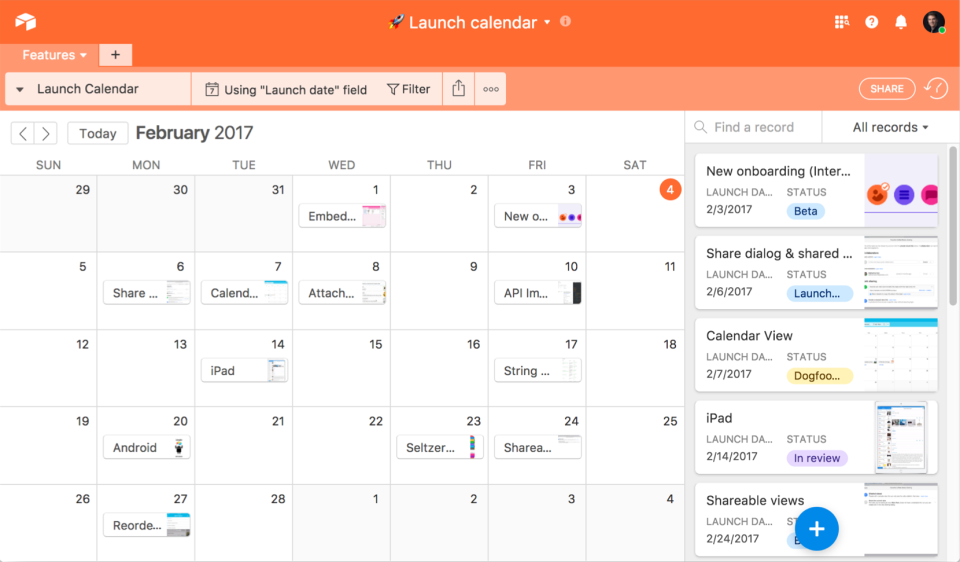
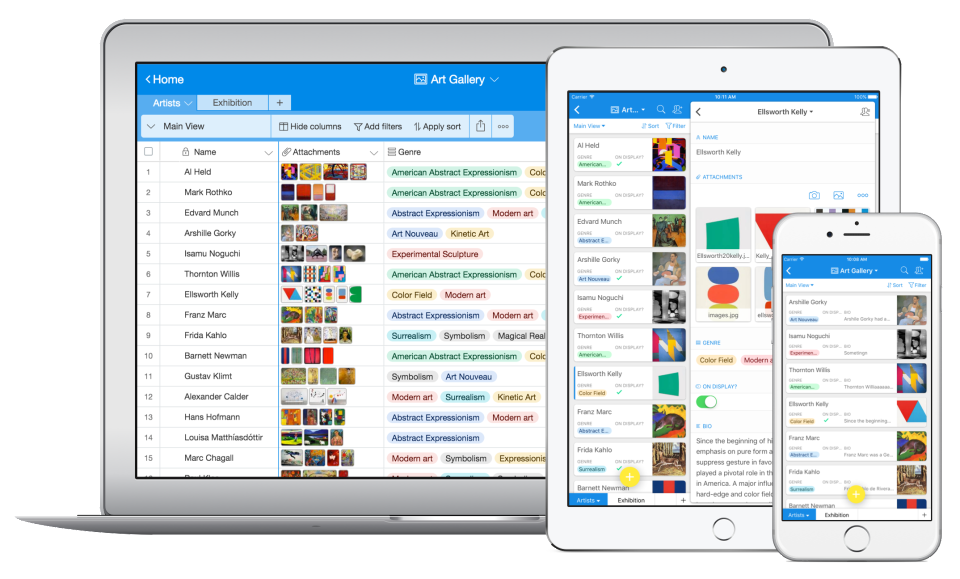
Airtable is a project management and collaboration platform designed to enable content pipelines, product management, events planning, user research, and more. It combines spreadsheet,database, calendar, and kanban functionality within one platform.

Media

Airtable
Airtable
Airtable
Airtable
Airtable

1 / 5

Top Performing Features

  • Task Management

    This includes the ability to plan, track, collaborate and report on tasks.

    Category average: 9

  • Support for Waterfall Methodology

    Waterfall methodology is a tradition development method that is linear and sequential.

    Category average: 7.9

  • Gantt Charts

    Gantt charts are charts that show tasks or events along the y-axis displayed against time along the x-axis.

    Category average: 7.9

Areas for Improvement

  • Budget and Expense Management

    Budget and expense management provides the capability to track all expenses by employee or department and link them back to department. It also enables hourly rates to be set.

    Category average: 7.7

  • Email integration

    Email integration allows work requests to be made directly from email.

    Category average: 7.6

  • Mobile Access

    Mobile access is the ability to access the software from a smartphone or tablet.

    Category average: 7.6

Make Better Use of your Spreadsheets with Airtable

Pros

  • There are some really strong pre-made templates, especially in the sales offerings (CRM, Pipeline).
  • It is so simple to add photos, documents, and multimedia, to spreadsheets (this is a feature that our team loves).
  • The collaboration features allow our departments to easily work together and better manage our teamwork.

Cons

  • The Advanced features seem a little intimidating and we haven't found easy ways to integrate them into our workflow. For example, my team does not use the app features, like scripting, page designer, chart, and pivot table, mainly due to the fact that we are not accustomed to using tools like these in our day-to-day workflows.
  • Copy and pasting from Excel files (and also exporting to Excel) can at times be a pain. When trying to copy and paste data from Excel to Airtable, the data can sometimes be displayed differently. Occasionally, we have to manipulate the data a little after it has been pasted to Airtable to make it appear as it did in Excel.
  • There have been some complaints on the performance and layout of the mobile version. Many of the desktop views that my team prefers are not available on the IOS app so we are not as familiar with the layout and navigation of the mobile version.

Most Important Features

  • We really like the ability to format the layout of our data into different views. The different views allow us to access and manipulate the data for our workflows.
  • The existing templates were incredibly helpful and gave our team a place to begin when organizing our data.
  • We like that we are able to pull from multiple sources of data into Airtable and how that data is synced into an aggregate view.

Return on Investment

  • It has really helped us move customers through the sales process more quickly and with better service.
  • It allowed us to cut down on the multiple spreadsheets floating around our office, which means our teams [wastes] less time looking for the latest spreadsheet.
  • Our teams collaborate better and [are far] more [efficient] with Airtable (it has eliminated redundant tasks in some of our processes).

Alternatives Considered

Asana

Other Software Used

Asana, monday.com, Trello

Airtable is a flexible and powerful tool for any business.

Use Cases and Deployment Scope

Tracking tasks for software development is my primary use, but the company also uses it to track inventory of computers and software, new hire status, from interview to termination. We've also used it for project management and project budgeting. We started out with a few small use cases but grew to be more dependent on Airtable as we became more familiar with its value. Now, we rely on its integration and use it like second nature.

Pros

  • Integrate with 3rd party applications.
  • External data entry via forms.
  • Tracking tasks across small to large team sizes.
  • Offers value without bloat.

Cons

  • Some automations could be easier to duplicate without loss of data.
  • Views could be sharable and deleted more easily.
  • Kanban views should be more customizable in appearance, size, fields, density of data.

Return on Investment

  • Increased communications across leadership and upper management.
  • Decreased the time it takes to hire new employees by increasing communication and organizing feedback effectively.

Usability

Alternatives Considered

Jira Software, Autodesk ShotGrid, Asana and Trello

Other Software Used

Slack, Miro

Surprisingly powerful very intuitive.

Use Cases and Deployment Scope

We used Airtable as a relational database to manage all aspects of our learning development programs. It was used to centralize information and plan new team member inductions, such as dates, workshops, progress, etc. It was also used for other data related to planning, project management, asset management, etc.

Pros

  • Relational databases.
  • Flexible UI.
  • Powerful automations.

Cons

  • Lacking spreadsheet features.
  • No sheet formula.

Return on Investment

  • Increase efficiencies.
  • Centralise collaboration.
  • Reduce manual tasks.

Usability

Alternatives Considered

Smartsheet

Other Software Used

Business Process Manager, Nintex

Best Low-Code Database

Use Cases and Deployment Scope

My organization used Airtable as a low-code "database" and project management tool. We weren't large enough to need "real" relational databases, and Airtable allowed our nontechnical users to easily perform CRUD operations and visualize information.

Pros

  • Custom views of tabular data.
  • Audit trails: who edited what, and when?
  • Custom scripts and automations.

Cons

  • When records are deleted, there could be more options for what happens to associated records in other tables.
  • Multi-select fields should be sortable.
  • The per-user pricing model can be cumbersome when you need to share bases with third parties but can't use a publicly accessible URL.

Return on Investment

  • Allowed us to centralize customer information from many different sources, saving valuable support agent time
  • Streamlined project management task reminders
  • Provided easy data entry for external parties

Usability

Alternatives Considered

Retool, Microsoft Excel and Google Sheets

Other Software Used

Slack, Google Chat, GDocs

Best database app for internal use

Use Cases and Deployment Scope

Structuring data is crucial, and Airtable is the best app for it. I use it as a single source of truth for finances (accounts and transactions), as a CRM (people, organizations, and form submissions), and much more. Paired with its powerful databases, it also offers robust automation capabilities, which I use for sending personalized auto-responses and much more.

Pros

  • Structuring information
  • Automation with structured information
  • Interface for interacting with information

Cons

  • It's only for internal use because it supports neither custom domains nor custom code. That's an Achilles heel

Return on Investment

  • Saves immeasurable time
  • Secures information from human vulnerabilities
  • Keeps information accurate

Usability

Alternatives Considered

Notion, Coda and Google Sheets

Other Software Used

Notion