Automox is an endpoint management platform built for the era of autonomous operations. It provides a cloud-native foundation that unifies automation, speed, visibility, and trust.
$1
per month per endpoint
ManageEngine Patch Manager Plus
Score 8.8 out of 10
N/A
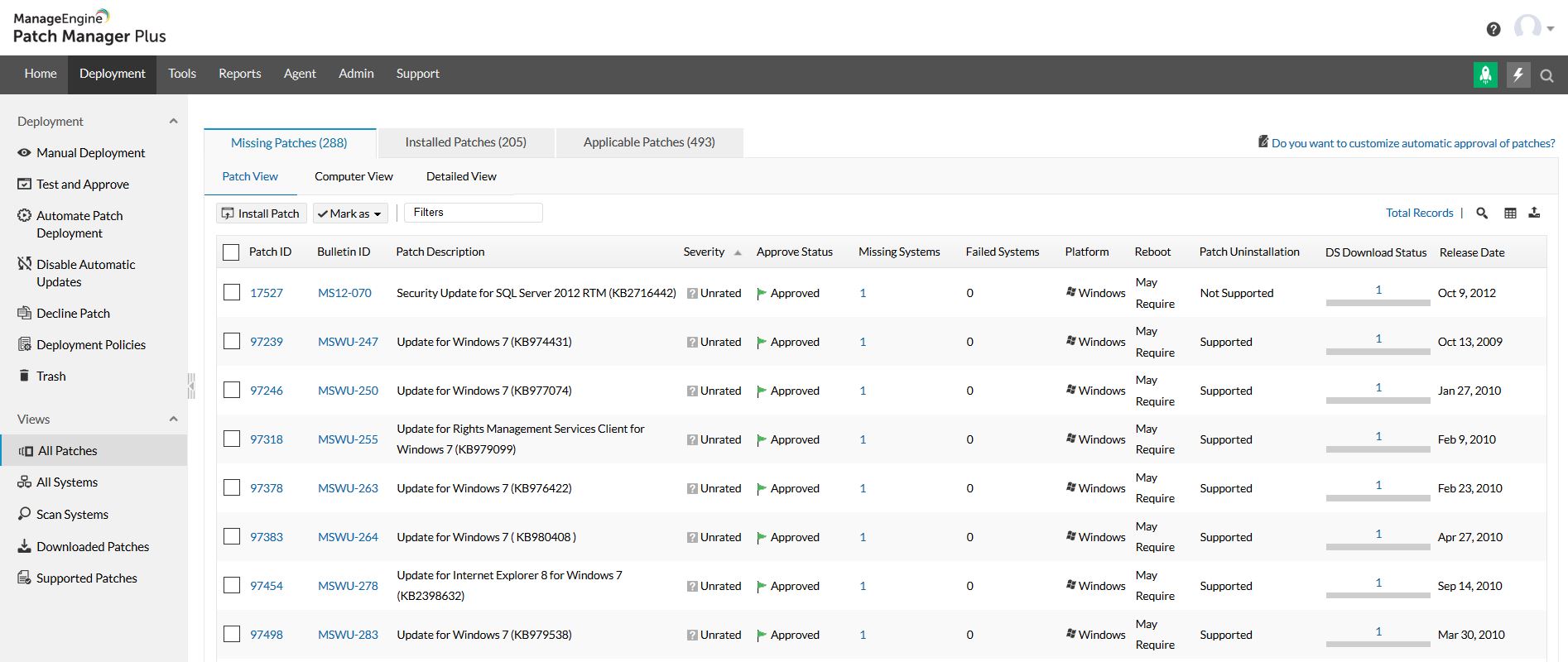
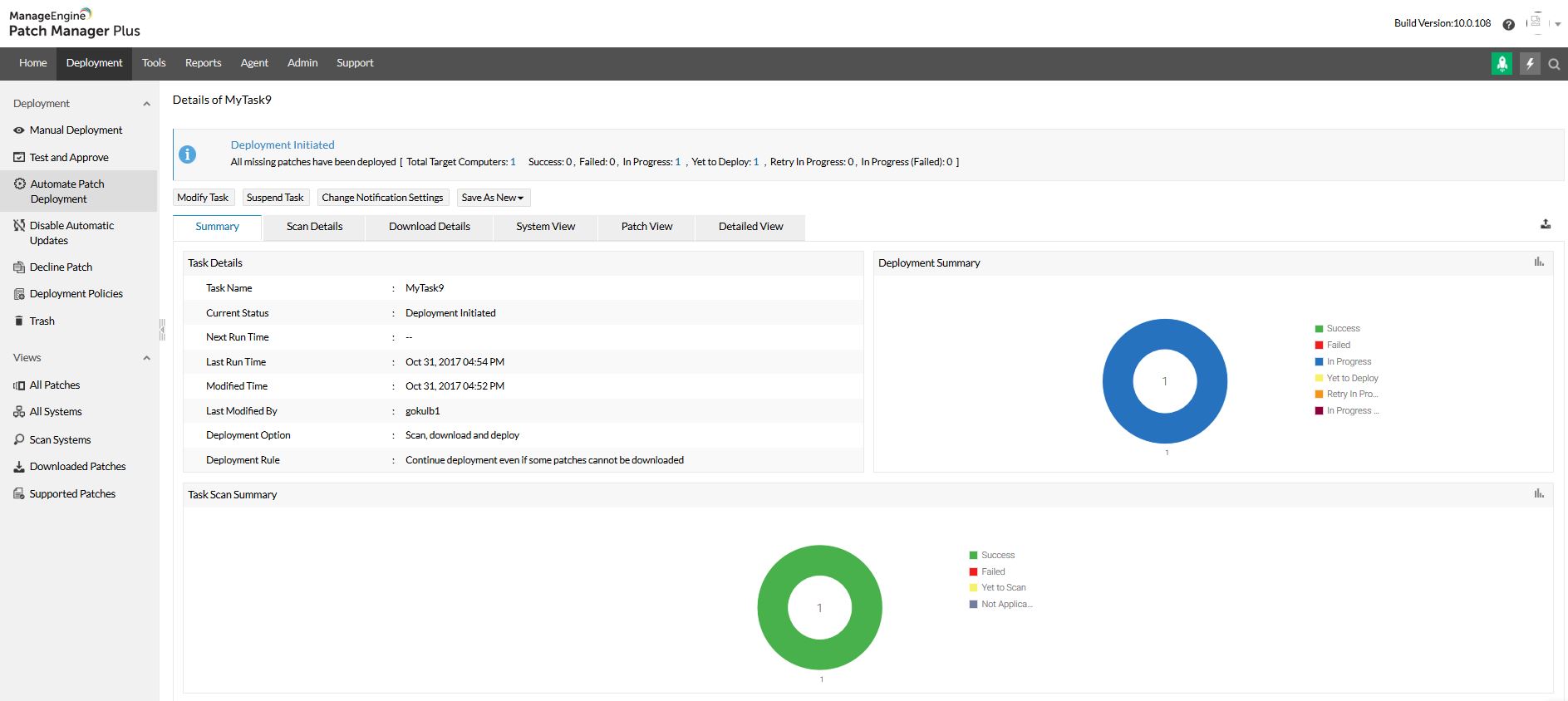
Patch Manager Plus is an automated patch management software that provides enterprises with a single interface for all patch management tasks. The vendor claims it works across platforms, helping users patch Windows, Mac, Linux & 300+ third-party applications. With Automated Patch Deployments, users can automate the entire process of patch management:…
$245
50 endpoints
Pricing
Automox
ManageEngine Patch Manager Plus
Editions & Modules
No answers on this topic
Professional
$245.00
50 endpoints
Enterprise
$345.00
50 endpoints
Professional
$345.00
50 endpoints
Enterprise
$445.00
50 endpoints
Offerings
Pricing Offerings
Automox
ManageEngine Patch Manager Plus
Free Trial
Yes
Yes
Free/Freemium Version
No
Yes
Premium Consulting/Integration Services
No
Yes
Entry-level Setup Fee
No setup fee
Optional
Additional Details
Automox can patch macOS, Windows, and Linux endpoints with PatchOS, an offering at $1 per endpoint/ month with an annual commitment.
The Automate Essentials or Automate Enterprise packages are for scaling IT automation, endpoint configuration, and software updates.
Modules are available with Automox Assist, a one-on-one remote endpoint control and assistance for helpdesk technicians.
Automox is cloud based vs PATCH MANAGER Plus which requires on premise servers. We consistently had issues with PATCH MANAGER Plus working on remote computers even with appropriate firewall rules and configuration. PATCH MANAGER Plus had an awkward interface. Automox …
Automox requires no server installation or maintenance. Pricing is competitive. It is cloud-based with a high level of uptime. I would recommend it to mid-sized businesses with a number of remote locations and different operating systems. It is simple to use and requires no …
The competitors I evaluated seem to be more focused on MSP customers, which is not our situation. Also I used Automox at a prior company with some success.
Smaller organisations such as ourselves, who have outgrown their MSP but still need to retain control of their system and have visibility of the estate. The tool enables us to have real-time visibility and deploy or remediate as needed. We have also purchased Rapid7, which integrates natively into the product, making it a more powerful tool moving forward.
If you are managing a very large number of computers, I would say 1000+, the standard patching tools provided by Microsoft will fail to do their job properly. This is where you will benefit from ManageEngine PATCH MANAGER Plus, being agent-based it is fast, easy to manage, and reliable. If you require functionality more than just patching, like security auditing, you have to look elsewhere.
Server patching orchestration. There is no way to patch and reboot systems in order of importance, such as database servers before application servers.
Worklets for patching .net core and similar.
Worklets for removing unwanted Java installs or other unwanted software.
Integration with Tenable Vulnerability Management.
AI script development should be included at no additional cost; GPT or Gemini can be used instead for free and pasted into Automox. Why charge when others are free?
Official worklets are slow to be added or updated.
This is a software that just works. Once configured its a set and forget kind of tool that keeps things up to date and alerts me if something is wrong. I was able to work through an expansion project to deploy an additional 500 devices in almost no time and create a robust self-patching environment.
It truly functions like a single pane of glass. While our use case is for EC2 instances in AWS, it can manage endpoints across all clouds, or even deployed hardware (laptops). We do manage instances in multiple AWS accounts and there is no set up required between orgs. This accomplishes our needs for real time tracking, and historical reporting for all of our in scope resources.
The overall usability for the application is great precisely for the ease of use the application provides, if i would go in a different organisation, i would suggest implementing ManageEngine Patch Manager Plus or Endpoint Central due to its features, and productivity.
I did not need to reach out to support often but when I did the answers were relatively correct and they were answered quickly. The only thing I might "ding" their support on was their lack of understanding of OS's different from Windows and especially Linux. Other than that I was satisfied
The support team at Patch Manager Plus has been awesome. Very responsive and knowledgeable. There are times when there is confusion between different tickets but there is still good service.
Implementing Automox successfully starts with a clear strategy for organizing and grouping devices based on operating systems, environments, or business criticality. This ensures that patching and configuration policies can be applied with precision. A phased rollout approach is essential—beginning with a pilot group allows teams to test patching schedules, reboot behaviors, and custom Worklets before scaling across the organization. Leveraging Worklets from the start can significantly boost automation by enforcing security baselines and performing routine system tasks. Integration with existing SOC tools, such as SIEMs, enhances visibility and response time by correlating patch compliance with threat intelligence. Additionally, aligning patching schedules with operational downtimes minimizes disruptions, and consistent monitoring and reporting helps maintain compliance and prepare for audits. Overall, Automox offers a streamlined and effective solution, but its true value is unlocked through thoughtful planning, testing, and integration with existing IT and security workflows.
All of these other products are overly complicated with user interfaces that are not very friendly.. too technical, even for IT pros. They are also expensive for smaller companies or those with limited IT budgets. I've found that these other solutions are really geared for larger enterprises more than small to midsized companies, which is fine... but then they tend to market themselves as good for everyone, when they are really not.
We were talking to Action1 and Adaptiva about their solutions of patch management. The main factor of choosing ManageEngine was pricing, which was considerably lower compared to these tools. Also, for Action1, it didn't featured some important features (like Linux patching), and it looked like a solution that is getting started in the market, even being more expensive than Patch Manager Plus.
Patches are now fully up to date and we have no longer been dinged for it from our pen testing partners.
Reduced man hours spent on maintaining an update server and the hours spent looking at each machine to ensure it patched all software both windows and third party.
Allows for us to provide a vendor with a means to connect to our systems without the use of a VPN.
It has saved engineers so much time when monitoring patching out of hours.
We no longer need to log into each individual server to patch it if it's failed, it can all be done from inside ManageEngine Patch Manager Plus itself.