Oracle’s Enterprise Manager is an on-premises monitoring and management tool. The console is designed primarily to manage other Oracle products, it but can integrate to manage non-Oracle components as well.
N/A
SolarWinds Server & Application Monitor
Score 7.7 out of 10
N/A
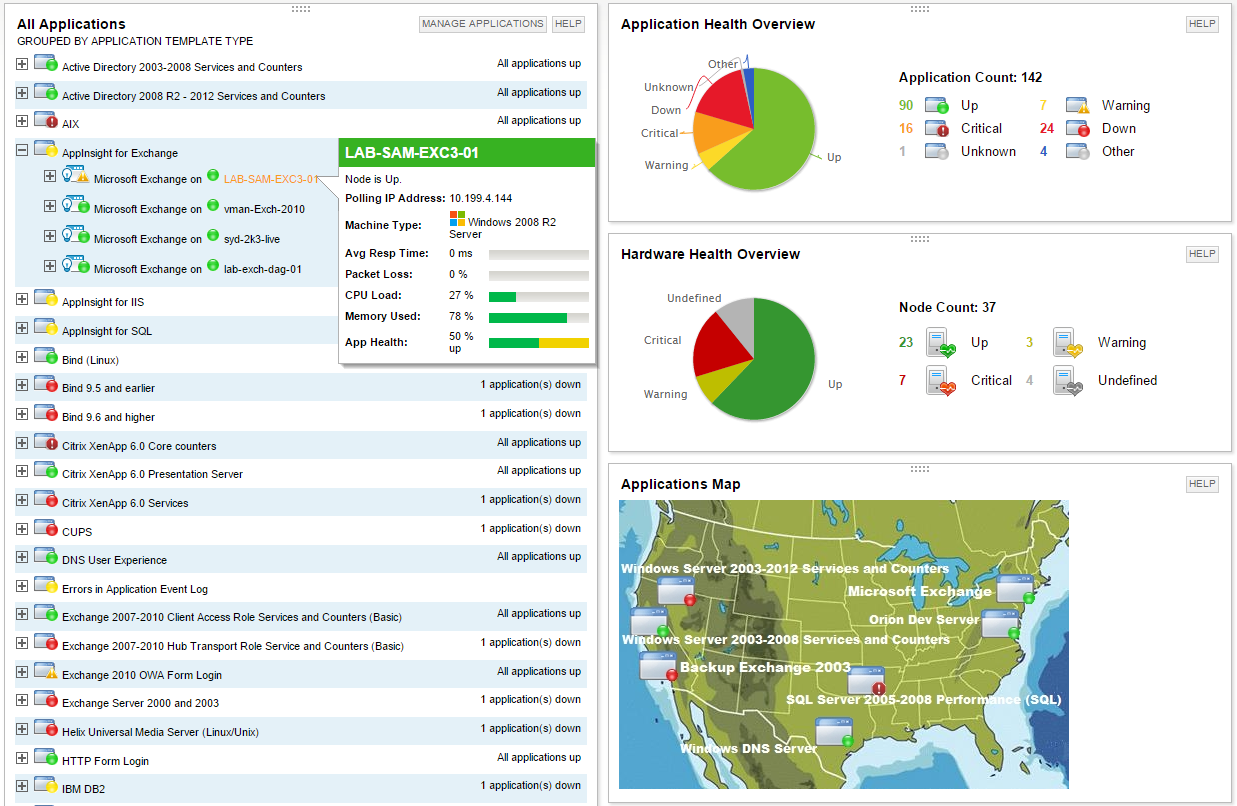
SolarWinds Server & Application Monitor (SAM) delivers application and server monitoring capabilities. SAM allows for self-service for easy setup, 1200+ monitoring templates, and customization options, as well as integrate with other SolarWinds products.
N/A
Pricing
Oracle Enterprise Manager
SolarWinds Server & Application Monitor
Editions & Modules
No answers on this topic
No answers on this topic
Offerings
Pricing Offerings
Oracle Enterprise Manager
SolarWinds Server & Application Monitor
Free Trial
No
Yes
Free/Freemium Version
No
No
Premium Consulting/Integration Services
No
No
Entry-level Setup Fee
No setup fee
No setup fee
Additional Details
—
SAM pricing starts at $2,995.
More Pricing Information
Community Pulse
Oracle Enterprise Manager
SolarWinds Server & Application Monitor
Considered Both Products
Oracle Enterprise Manager
Verified User
Consultant
Chose Oracle Enterprise Manager
OEM is better at monitoring applications, while SolarWinds is better at monitoring the underlying infrastructure such as networks, switches, and routers.
OEM is very well suited for all Oracle products, especially Oracle databases and Exadata machines; even not Oracle hardware, it is very good and displaying high level details. OEM is not well suited for older hardware vendors like AIX, HP-UX, DEC/Digital, Microsoft (sql server). This is a big negative as most large companies have a heterogeneous environment with many different vendor hardware and (database) software products.
For monitoring applications that run on Windows hosts on VMware or HyperV virtualization, SolarWindows offers a nice, vertical view of both the loads and the resources. In such an environment, this makes life really good! But if you have something else -- for example, Linux hosts -- you're on your own to some extent. That is, the things it does well, it does very well -- but everything else is much less polished.
Monitoring Templates: There are out of box monitoring templates for each target types, you can customize them or use them as it is.
Administrative Groups: This is a relatively new feature in OEM Cloud Control. This lets you create and manage your targets and monitoring templates smarter and with less re-work.
DB Monitoring: There are so many cool DB monitoring features and visual graphics, that it can be used by both DBA and functional people to see what's going on in the database.
Bugs. Every version we upgrade to has a number of bugs. Some stop us from rolling to production OEM (we have a sandbox OEM), some are simply annoying. If I could improve on one thing, it would be for better QA from oracle before releasing each version.
Flash. I'm told that they are moving from Flash to Jet in version 13.3 and beyond (we are on 13.2 currently). That change cannot come soon enough. The OEM pages load SO slowly due to Flash.
Hierarchy Groups. OEM allows five Hierarchy groups. A Hierarchy group allows a top down metric/rule roll out. However, they limit you to five. I'd like to see them open that up, so that we can have any number of custom groups.
Provides basic monitoring/visibility. Visibility into detailed/fine-grained issues best suited for more specialized/expensive solutions.
Licensing per monitored application rapidly uses up purchased license count.
More out-of-the-box templates or easier setup of monitoring less-common applications would make the solution more appealing given the target audience of the product.
We are heavily invested in Solarwinds products for a reason. They are generally easy to setup and run with, requiring only some interfacing with support or help articles on rare occasions. They do what we bought them to do and we can't ask for more.
It's great! It does everything and anything you would want it to do. It can monitor things which doesn't comes out of the box by adding plug ins to it, for example, you can even monitor Oracle GoldenGate Replication by adding a plug-in to OEM Cloud Control.
SolarWinds Server & Application Monitor is quite easy to use and super versatile. It allows you to do just about anything you can through premade templates or through scripting. You can use an agent on the servers if you want to, or you can monitor through WMI or SNMP credentials. You can customize thresholds for alerting quickly, and you can configure alerts to be as complex or as simple as you want.
The graphical interface and the performance of the database leave a little to be desired, they could be better explored.Some functionality and screens do not work well depending on the browser used. The integrations never had any problems or caused crashes in other systems.
I still rate OEM as a must-have tool for central management of Oracle fleet. The pros and cons of the product is prominent. Meanwhile, I also acknowledge that OEM was design about a decade ago. At that time, it did not have the landscape we have today, such as cloud, DEVOPS, machine learning, etc. I hope in future releases, the design will incorporate those features.
I think there was only a couple times I had to open a support case for SAM and one time they got multiple engineers on the phone to get a better idea what I was trying to monitor and was able to point me in the best direction to monitor that system.
Being an Oracle shop using Oracle Database and MySQL, management console from Oracle was a better choice than IBM or Microsoft even though we do use Microsoft Azure and storage/servers from IBM (on-prem).
It has been a while since we first purchased SolarWinds, but I looked over several other products that I can't remember now. Many other products tried to scan the network to find computers but given that our computers are located in various places across campus with other computers in our buildings that are not ours that type of network scanning was not what we needed. Other services have extra services that we had no need of and I liked the ability to add custom fields in SolarWinds so we can track the information on each computer that we need to know.
We are a 7x24 shop. Oracle Enterprise Manager Cloud Control helps us meet that objective by proactively warning us before issues cause down time. Things like disk space, archive log issues or temporary table space issues.
Spreading the use of this tool outside of the DBA group has allowed us to not hire additional personnel for those teams. Over time, as folks have retired from our operations team, we are not replacing them. Instead we have used OEM Cloud Control to automate tasks.
We also now have the tools to measure up-time by using specific measurements inside of OEM. This allows us to report real numbers to management.
Less time spent investigating causes of issues. We are alerted straight away and can find the root cause of the issue in less time.
We have been able to ditch all our previous individual monitoring solutions, none of which integrated with each other for a single solution which fully integrates with each of the different modules to provide a single portal for monitoring and alerting.