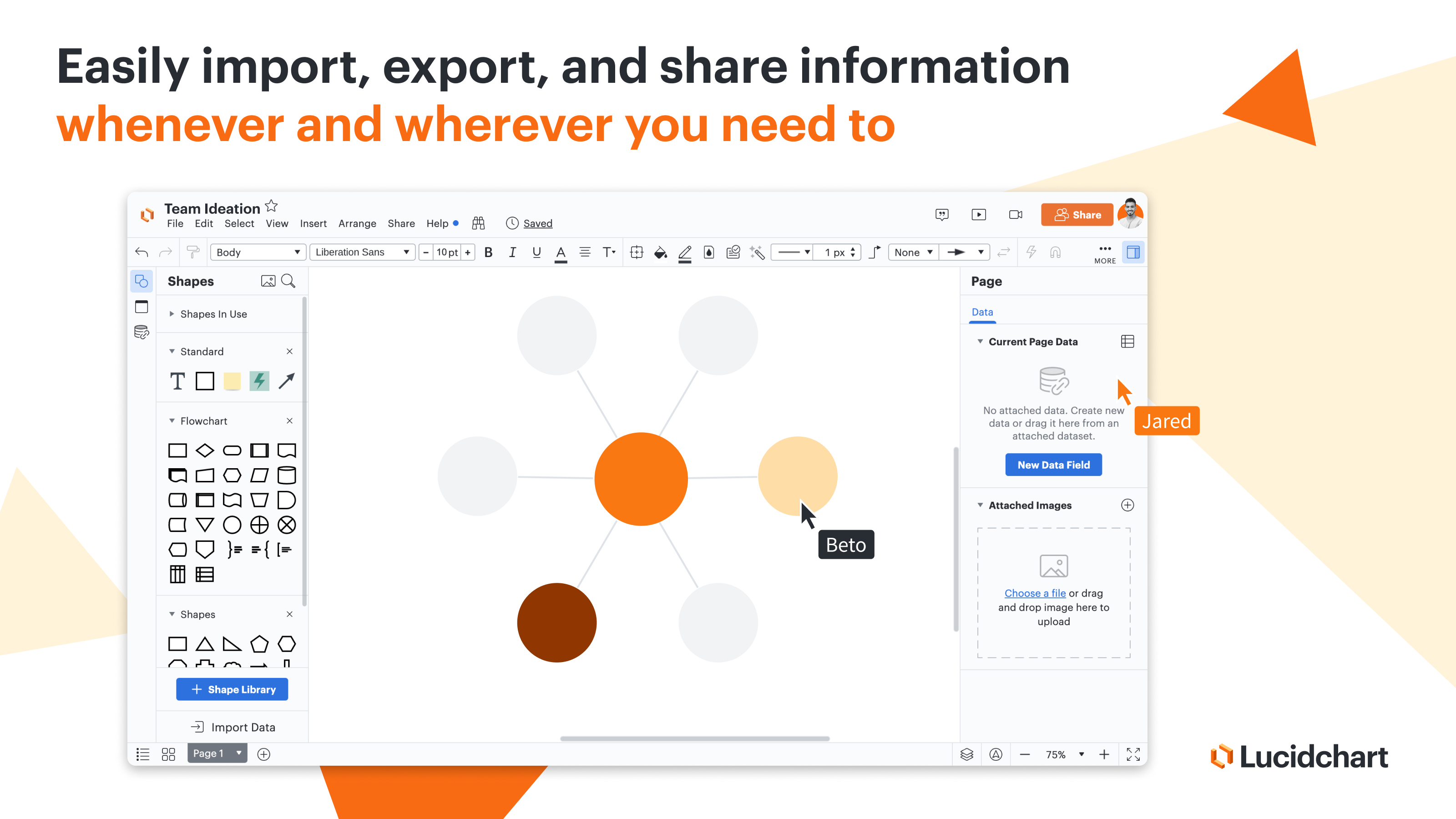
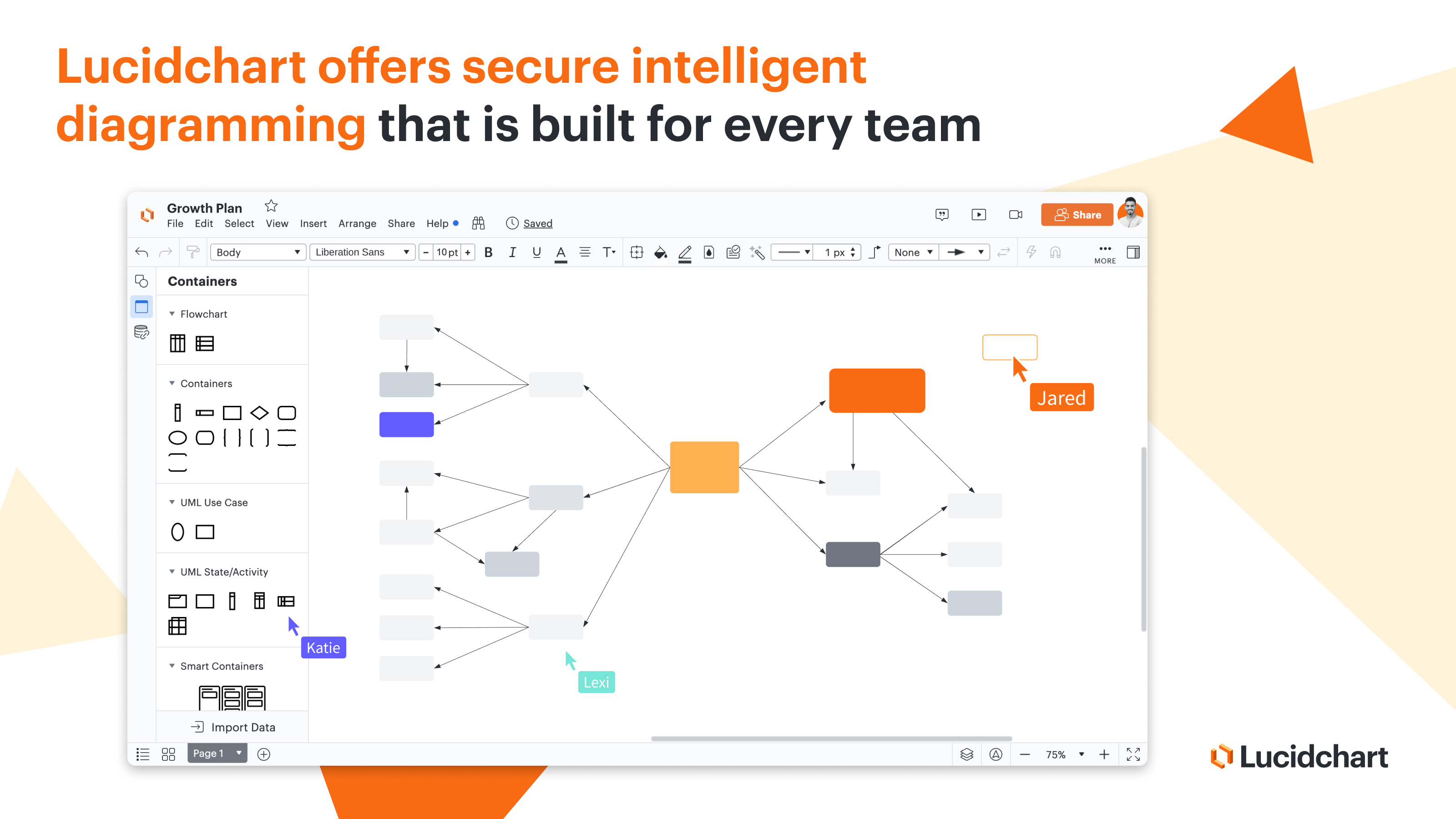
The Lucid Visual Collaboration Suite empowers teams to ideate, plan, design, build, and launch game-changing solutions from a shared infinite canvas.
$0
per month
Miro
Score 9.1 out of 10
N/A
Miro empowers cross-functional teams to flow from early discovery through final delivery on a shared, AI-first canvas. With the canvas as the prompt, Miro’s AI capabilities keep teams in the flow of work, and scale shifts in ways of working.
$10
per month per user
Pricing
Lucid Visual Collaboration Suite
Miro
Editions & Modules
Free
$0
Individual
$9
per month per user
Team
$10
per month per user (3 user minimum)
Enterprise
.
per year
1. Free - To discover what Miro can do. Always free
$0
2. Starter - Unlimited and private boards with essential features
$8
per month (billed annually) per user
3. Business - Scales collaboration with advanced features and security
$16
per month (billed annually) per user
4. Enterprise - For work across the entire organization, with support, security and control, to scale
contact sales
annual billing per user
Offerings
Pricing Offerings
Lucid Visual Collaboration Suite
Miro
Free Trial
Yes
Yes
Free/Freemium Version
Yes
Yes
Premium Consulting/Integration Services
Yes
No
Entry-level Setup Fee
Optional
Optional
Additional Details
—
Monthly billing also available at $10 per month for the Starter plan, or $20 for the Business plan.
If it's solo work, I prefer Lucidchart over all its competitors. For larger group collaboration, Lucidspark or Miro is much much preferred than Lucidchart. Figma is ok for some basic use but can't handle complex stuffs. MURAL and Visio are just terrible products to use in …
Miro is good for workshops and project planning but Lucidchart is more useful for architectural diagrams but it does not have stickers and fancy colors like in Miro used in workshops
Lucidchart, draw.io, Miro all deliver the same core functionality of diagramming software. Lucidchart has integration ecosystem, with so many tools/apps (Asana, Google Sheets live connector, Saleforce, etc) that why enterprises and business choose Lucidchart. Compared to Miro, …
Verified User
Consultant
Chose Lucid Visual Collaboration Suite
I like Lucid Visual Collaboration Suite more than both of those for the ease of use and collaboration. Miro is similar with collaboration but didn't find as easy to use and Visio is similar to use but a bit harder to collaborate with.
I have used Miro, but we use them for different things. There's not much I can compare as we use them only for what each one of them is strong, but if I had to compare, Miro doesn't have the power to deal with database diagrams like Lucid Visual Collaboration Suite Lucidchart …
Miro had an advantage with the unlimited canvas until Lucidchart recently added that feature. Lucidchart seems to be better designed for creating drawings, incredibly technical or software architectural diagrams. Miro appears to be more designed for non-technical folks as a …
I did not select Lucid Visual Collaboration Suite. That decision was taken by others in the organization. Given a choice, I am not sure I would have selected Lucid Visual Collaboration Suite. Miro was already established and, with a local client, was a better user experience in …
Lucid Visual Collaboration Suite has a more professional feel, an easier way of organizing and a simpler look. Miro, while very similar, has more aggressive color schemes and a more toy like UI that does not inspire as much confidence in our stakeholders.
Based on my personal experience, Lucid Visual Collaboration Suite is head and shoulders above any other competitor. Canva is good, but not intuitive at all. Miro is good as well, but not nearly as appealing and still lacks some of the logical functions that LucidSpark has. I’ve …
I think that many of these tools are great, I use Lucidchart because that's what our company uses. I think Lucidchart is better than draw.io. Canva and Figma are different use cases (for me) than Lucid Visual Collab. Figma I would go to for UI design, while Canva for me is …
While all of the other platforms we have evaluated and some we even use, Lucid has it's own unique solution and aesthetic that we find to work well for us for many of our different deliverables. There is no "One-App-Does-All" solution out there, however, when it comes to …
Lucid Visual Collaboration Suite is the best in class for documenting anything technical. It has all the templates you would need to represent anything from AWS, Microsoft as well as workflows for business processes. Other tools might cover just one of each of these things, but …
Much better, it doesn't get the steps in lines even a tenth as much as Visio, can use custom shapes as actual shapes rather than images, and aligns much easier. Lucid Visual Collaboration Suite is easily the best and I have tried about 4-5 programs over the last 5 years.
draw.io is a free tool which has very limited functionality. Some of the advanced features like AI based generation and templates are not available in other applications. Also, I’ve used bot framework for different purposes. If customer wants to collaborate and they don’t have …
SmartDraw's templates appeared to offer more selection and were slightly better. They offer desktop apps for Mac and Windows (if that's your thing). However, we feel that Lucidchart has better sharing and collaboration tools and we opted to go with this software over SmartDraw …
We started using LucidChart after switching from another visual collaboration tool. The import process worked surprisingly well - way better than anyone on our team was expecting. Lucidchart itself is simple to use, easy to collaborate with coworkers, has a ton of built-in …
I think Lucidchart is just better for diagramming complex engineer scenarios. For software engineers, it's really hard to beat. I do like these other tools I have listed, but my favorite is still Lucidchart because it has so many high-quality features that really matter for …
Miro is far superior to lucidchart. More robust tool set. Frames, ease of use, AI tool, presentations, and not just diagramming. Commenting implementation. Miro, compared to PowerPoint, is also better in my opinion, with the modern templates, editing, presentation mode, and the …
lucidspark is doing great but still delivers a disjointed experience (some features in Lucid Chats, others in Lucid Spark) - They do a better job providing pages inside the document - also more flexibility with customization
FigJam is deeply integrated to Figma, so brings some …
Compared to the others, the platform offers a far more extensive feature set and a sleeker, more professional UI/UX, making it ideal for creating professional-looking diagrams.
Miro is leaps and bounds ahead of One note in terms of functionality, useability and collaboration. OneNote can be useful for taking basic notes or working on something individually but i would never use for anything visual or collaborative.
These two alternative products provide a smoother UI experience. They are more suited for engineering diagrams. However, Miro seems to be better for collaboration, whiteboard, and sticky note experience.
Miro is easier to use and the UI is much better. Therefore, it was a clear winner and that is why it remains and the go to choice in the industry. We value it for how it allows us to store information and enhances collaboration amongst team mates and different teams.
The feature set, premium-quality perception, and leadership in the market. Ai-powered features are also an important plus, together with a growing community of advocates and product enthusiasts who contributes to create templates and give advice on how to use and improve the …
Lucid is the closest in functionality, but we find it is easier to "guest" in contractors and other external contributors using Miro. Visio is useful for architecture diagrams, but the online colloboration and it's usefulness for other use cases mean that it is used less. Figm…
Of all other solutions, Miro seems the most intuitive, the fastest, and the most stable. Rarely if ever crashes or has stability issues and we can get other teams that have never used it collaborating in it within 5 minutes of explanations (not additional meeting needed to talk …
We use a lot of products, each have their advantage. Miro has the best templates and also provides the best training. Lucid has some better data centre hosting location options and also account management team is very good.
Lucid made it easier to make process diagrams, but Miro offers more functionality. It's a more versatile product, and it is easier to have all the information in one space.
We use both in our business. While lucid's process mapping cuntionality is better than Miro's, i find that Miro is more intuititve and user friendly to use and has a better overall UX. The templates in Miro are also better in my opinion than the ones that can be found in Lucid.
I personally think that Lucid Visual Collaboration Suite is the best visual collaboration software out there. I’ve used Canva, Apple Freeform, and Microsoft whiteboarding software, and none of them really measure up. If you want simple, easy, collaborative, and intuitive, then Lucid Visual Collaboration Suite is the best solution. At the same time, if you’re tight on budget, it’s probably not going to be a solution you can afford.
For me, Miro works best for messy internal processes. One of the instances include there are updates in math guidelines or reorganizing how topics should flow. I can put everything on the board, drag things around, color code it, and suddenly everything actually makes sense. It's also a common interacting space for the team to think out loud. Keeps everyone aligned without different documents floating around. It has a downside too. When the board gets big and full of screenshots or reference files, it slows down and I have to wait for things for so long.
Large number of predefined charts, diagrams, flows
A great repository of various symbols and objects
The easiness of using and manipulating objects and shapes. There is a lot of auto-editing and adjusting which the software does for you which saves a lot of your time.
Easy way of duplicating shapes.
While working with the app everything feels organic and natural. You don't get the clunky/limited feeling which happens with some other similar apps.
I have used the templates before and those are nice! I would like to see more
The ONLY complaint I can come up with is that there has been several times that my screen will lock up and i have to fully refresh it, even when it is a fairly fresh load.
Sticky notes cannot be easily resized. It would often be useful for them to transform into workspaces, because they become actual text content rather than just notes.
Perhaps there is no option to sort the work boards according to specific criteria (such as alphabetical order or date).
The various functions available should perhaps be explained clearly with a tooltip or something similar while you are working with the various tools. I often don't realise that certain things can be done.
I have advocate for the renew of Miro quite few times, however, it is not under my control as the decision is made in another team with their own budget. I would buy for my own entrepreneur projects (1-2 members) as I do know the value and work there 100%. So, I would pay out of my own pocket to get the value. However, If I wouldn't know the value it provides, it would be hard to decide with the current freemium features
The usability of Lucid Visual Collaboration Suite is bar none and incomparable to any other tool used in the past. There is such a vast offering that covers all the needs of any user in industries far and wide. It is no doubt that this is a firm recommendation for anyone and everyone to utilize this tool for all their needs.
Solid usability, we transitioned from Mural, so some of it is a learning curve from what we were used to in the prior tool. As previously mentioned, the scrolling feature and moving around the board is not as intuitive as I would like. Outside of that, the functionality seems to mee the expectations we have for a collaboration tool
I only give a 9/10 because of the speed at which it loads. I have never experienced issues with Miro logging me out early, or some other technical issue causing the program to crash, or even it just loading in perpetuity without ever actually coming up (unlike other programs such as SFDC). It take a minute for all of my boards to come up after I click on it in my favorites, but besides that, it's all good.
Sometimes it gets quite slow and there is a correlation between this and the size of the board. Hence we are trying to segment the boards based on product stages or projects so that the size doesn't go big. When you go from discovery to delivery on a simple board, it will get large and difficult to load, even crash or go white screen
I would rate the overall support for Lucidchart as a 9. The support provided is generally robust and responsive. Their help center, tutorials, and webinars offer extensive resources for users. The ticket-based support system is effective, providing timely resolutions to most issues. Moreover, they actively gather user feedback, demonstrating a commitment to continuous improvement
We have never reached out to or contacted support because Miro's platform has been incredibly intuitive and user-friendly. The comprehensive resources available, such as tutorials, documentation, and community forums, have provided all the guidance we needed. The seamless integration with our existing tools and the reliability of the platform have ensured that we rarely encounter issues that require external assistance. This self-sufficiency has allowed us to focus more on our projects and collaboration without interruptions. Overall, our experience with Miro has been smooth and efficient, eliminating the need for additional support
There was a series of webinars which Miro hosted with our organization that went over the basics, then progressively became more advanced with additional sections. The instructors were knowledgeable, and provided examples throughout the sessions, as well as answered peoples' questions. There was ample time and experience on the calls to cover a range of topics. The instructors were also very friendly and sociable, as well as honest. Of course Miro isn't a "God-tool" that does absolutely everything, but the instructors were aware and emphasized the strengths where Miro had them and sincerely accepted feedback.
Easy to learn, Miro has a series of videos on YouTube that effectively taught this program to my team members and me. The program is drag-and-drop and works excellently. People pick up on how to use it efficiently, and it's great for organizing ideas more freely. This product is more challenging for some older audiences who are not accustomed to using a touchpad, but for most, it was very easy to use.
Lucidchart is well beyond Microsoft Visio and is constantly improving. Visio is pretty much stagnant and hasn't been improved for several years, Lucid is constantly adding new functionality like AI powered functions and tools. We have no reason to pay for Visio licenses when Lucid can provide so much more for less.
While not as feature rich to be honest as some of these focused tools, it still replaces a vast majority of them. It is enough to make it easily replace the listed tools if you wish to do so. This not only saves time pivoting between tools, but also money with licensing which is an easy sell to my management.
Maybe is possible now so... Could be useful to manage in some way source code for the projects? not to edit so when we make solutions with different components in MIro, maybe each component could redirect to the source code of this component
It sure has. It has saved me a lot of time. Think of all the time I could have wasted trying to learn a program that does the same thing, whereas Lucidchart just does it with ease, learn as you go, and be a boss at it.
Lucidchart has increased productivity. My diagrams have helped co-workers find connectivity and helped them troubleshoot devices. This has saved time and increased productivity.
We did a dynamic activity based on actionable insights from a research study that I conducted. It was great to see people interacting, and one of the proposals was successful, resulting in a 6 million (in local currency) contribution to the company!