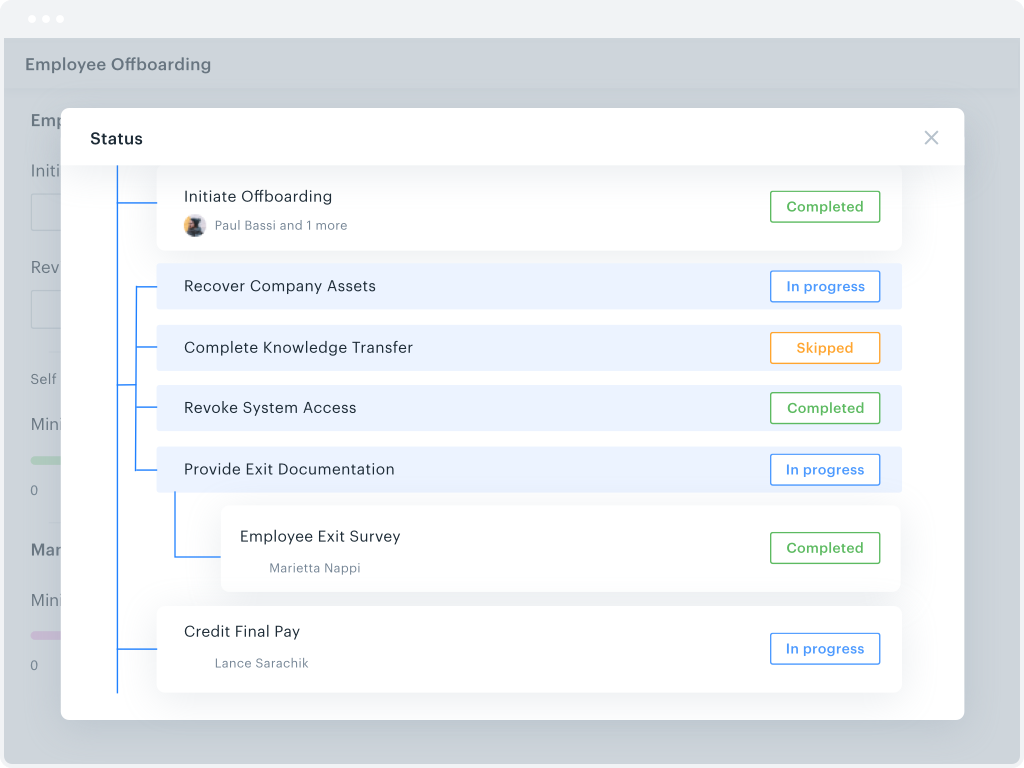
Kissflow is a low-code platform for custom application development tailored to business operations. Kissflow empowers process owners and IT developers to automate and build processes and applications for internal business operations.
$1,500
per month 50 Users
Mendix
Score 8.0 out of 10
Enterprise companies (1,001+ employees)
Mendix is a low code platform-as-a-service offering with mobile and social extensions. Mendix was acquired by Siemens August 2018.
$0
Pricing
Kissflow
Mendix
Editions & Modules
Small Business
$1500
per month
Free Edition
$0
Pro Edition
1,250
per month (billed annually)
Enterprise Edition
1,675
per month (billed annually)
Offerings
Pricing Offerings
Kissflow
Mendix
Free Trial
Yes
Yes
Free/Freemium Version
No
Yes
Premium Consulting/Integration Services
Yes
Yes
Entry-level Setup Fee
No setup fee
Optional
Additional Details
—
—
More Pricing Information
Community Pulse
Kissflow
Mendix
Features
Kissflow
Mendix
Low-Code Development
Comparison of Low-Code Development features of Product A and Product B
We've used Kissflow [School Cloud] in order to track parent requests for transportation in the SpEd department. It has been user friendly for parents to input a request and staff to review, double check school sites and locations, and set up specific routes to meet the needs of students and communicate the info back to parents.
Mendix excels in scenarios involving Business Process Automation, making it a strong choice for applications requiring workflow automation, including processes like request approvals, document management, and other business workflows.Conversely, Mendix may be less suitable for projects that demand highly customized solutions with extensive custom coding. Its primary focus on low-code development may not align well with the requirements of projects that heavily rely on intricate and specialized coding.
They know what they are. You aren't going to get a Workflow program that also wants to be a CRM. You will get the equivalent of an electronic assistant going from station to station, taking care of business and giving you the end result.
Paper. It reduces the amount of paper needed for menial tasks tremendously. You can automate an entire process. As an educational institution, you may still need paper copies, but you aren't waiting for John Doe to sign Line 3, then Jane Doe to initial, and so on and so on with a paper form.
Tracking. If you need to know where things are in the process, the fact that this program is dedicated to workflow makes it incredibly easy to identify where people are in the sales flow.
Customer appreciation. When your workflow is stronger, faster, and better, the customers feel it. They feel like you are right there with them and getting things moving.
We're able to really easily develop different views that are very specific to a customer's needs or customer's different types of user needs. So for example, the production managers can have a certain view that's relevant to them and then certain line managers can have views that are specific to them that allow them to run different scenarios which they define. So it allows us to easily build customized apps for each different type of user.
Workflow Design: There isn't a copy/paste function when creating the workflow, and you can't move a workflow task between parallel branches. This becomes a pain point when an item has 98% of what you need, but you can't copy it and place it in another branch to make the last tweaks. Instead, it needs to be completely recreated
Interface: While I like the current design features, which make it easy for an end-user to find their tasks and items, it would be nice to also have some flexibility within the platform. Things like being able to groups apps under a category or tailoring the look and feel of the page a little more would be a welcome addition.
The system has room to grow as it's limited by not being able to edit POs after they've been approved. The system is great for registrations and syncing to other systems while including the attachments. The reporting from Kissflow is also easy to setup to link to other platforms such as Looker
A 10 would say I have nothing to wish for. A 9 means I haven't seen anything better.This tool really helps you in the whole creation and maintenace cycle, so from requirements to building/modeling to testing to deploying to capturing feedback.
I haven't encountered a need for support with KiSSFLOW. It's not a perfect platform, but it's functional, dependable, and reasonably intuitive. I can't fault a support team just because their product works!
Response times are quick and you will get updates regularly about the status of your request. Even with very technical questions they have specialists that can help you with your problems it will give you an answer or help you with a work around.
KiSSFLOW is much easier to set up, less coding and easier to explain to those that are being trained. The company already had SharePoint, but it is a very difficult system to set up. A class had to be taken, along with getting books in order to understand the process of the workflow. With KiSSFLOW, it is simple to understand, the helpdesk is quick with their response, help topics are laid out simply and you can even talk with someone on that side to ask your questions. Overall, KiSSFLOW is a much easier workflow and system to use.
Mendix would be my preferred system all the way. The system is designed for these kinds of works. I've worked with WP and DNN but they should be used just for websites. To create an app for a business value, I would suggest Mendix. Also, the offline capabilities of Mendix have greatly improved since the deployment of Mendix 7.13.
The only real hard number savings that we have had with KiSSFLOW is the money we have saved in forms being printed, especially multi-part forms. So for a small college like us that it probably in the $5000 to $10000 per year range. We have certainly saved money in increased efficiencies of the processes that we have moved to KiSSFLOW. But that is harder to calculate.
It helps to speed up application development because of its low code by the fact that it's low code. It allows professional developers to focus more on specialized application development rather than the more routine application development that business IT and super users can do for themselves with some coaching from the IT department. So it's just allowing the more specialist professional developers.net, for example, Java in our organization to focus on more complex engineering application developments.