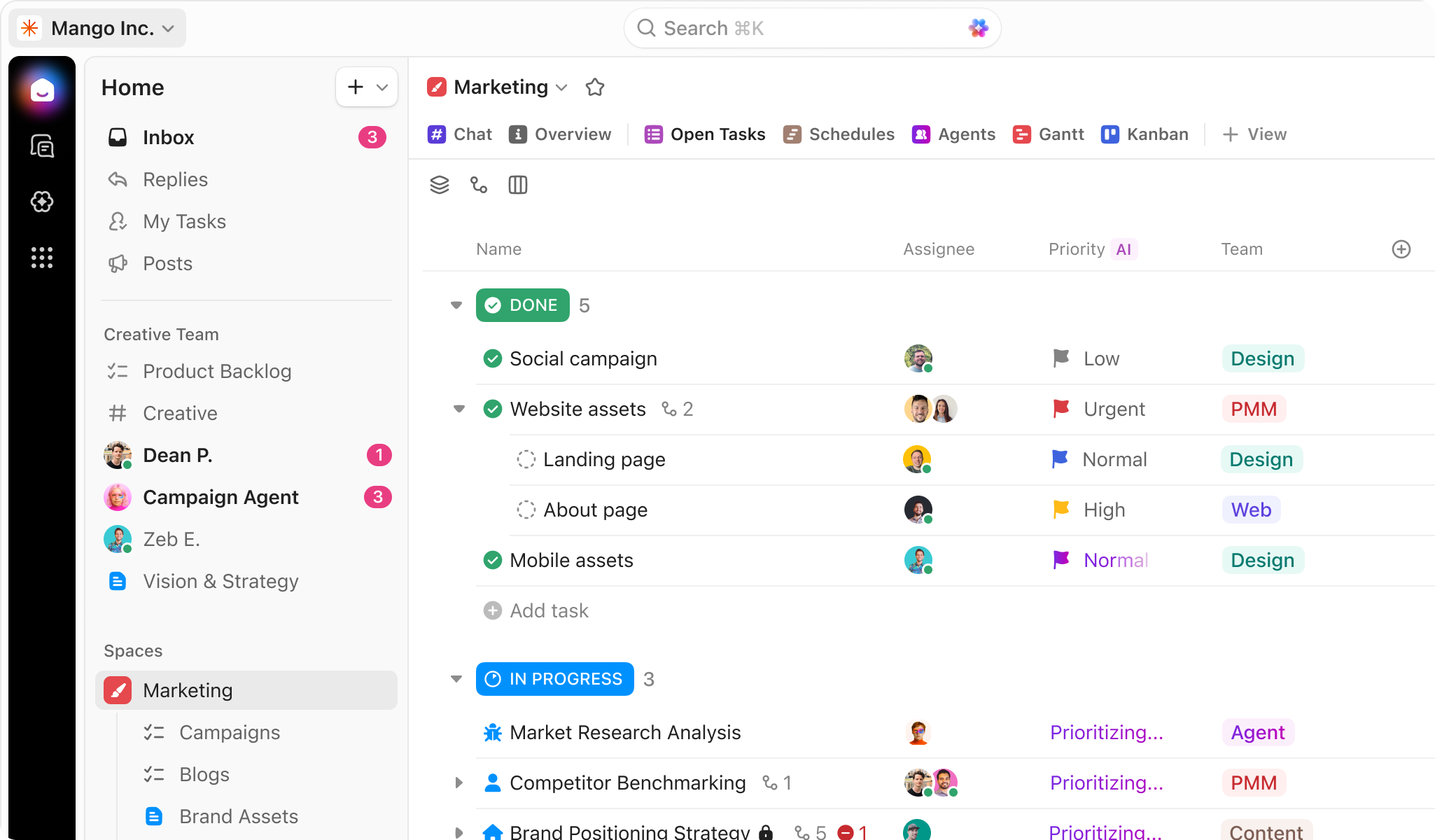
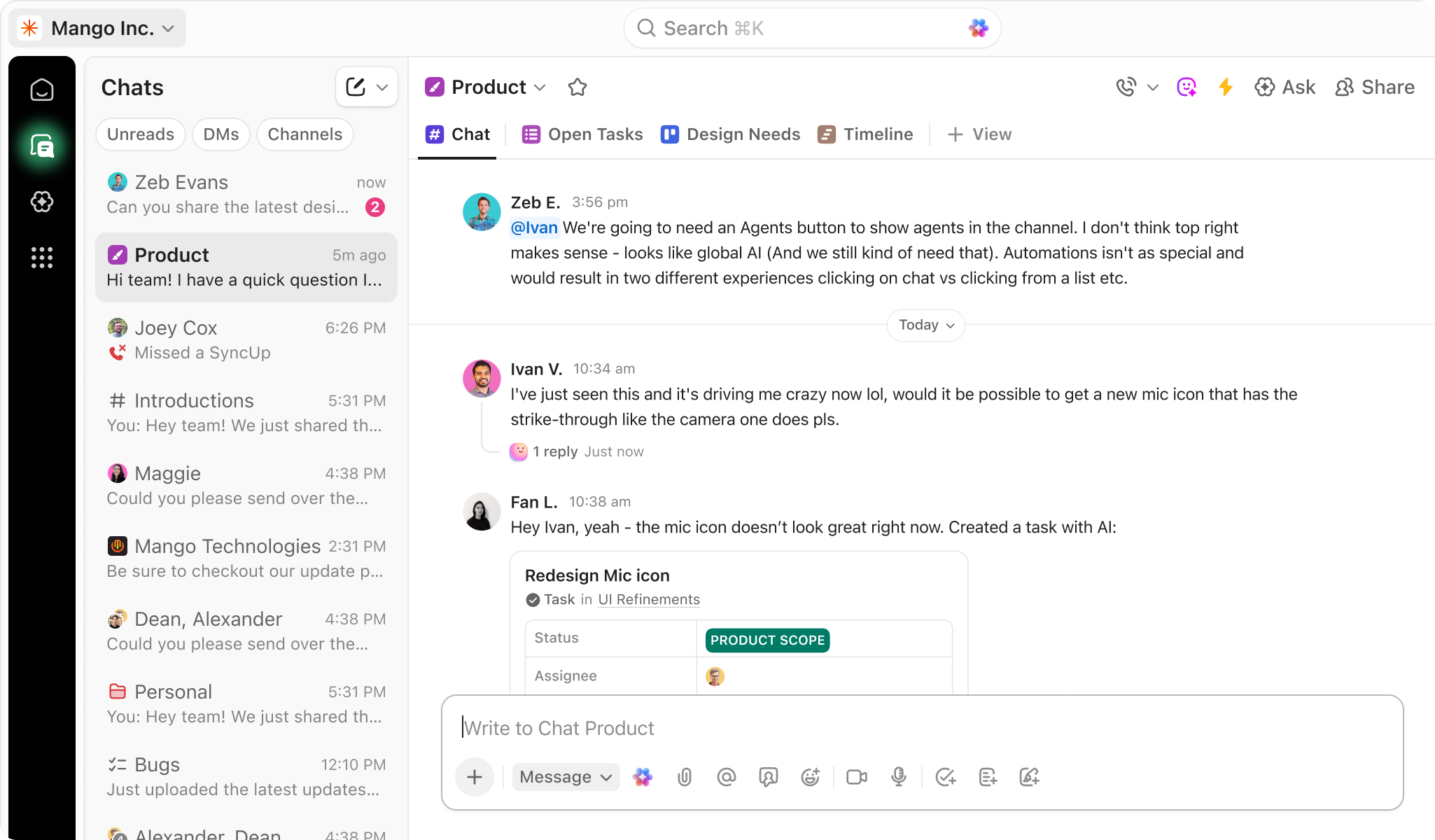
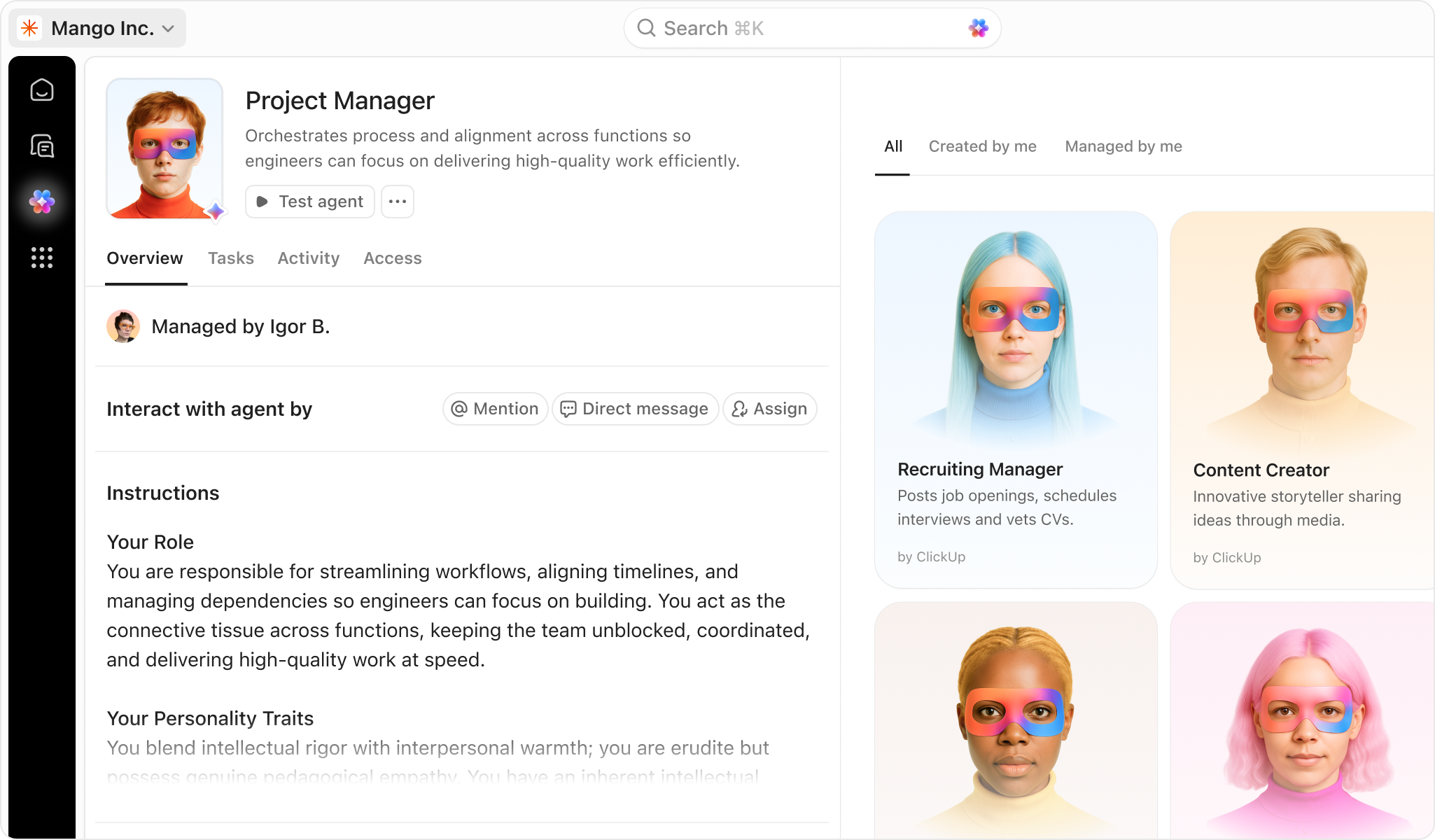
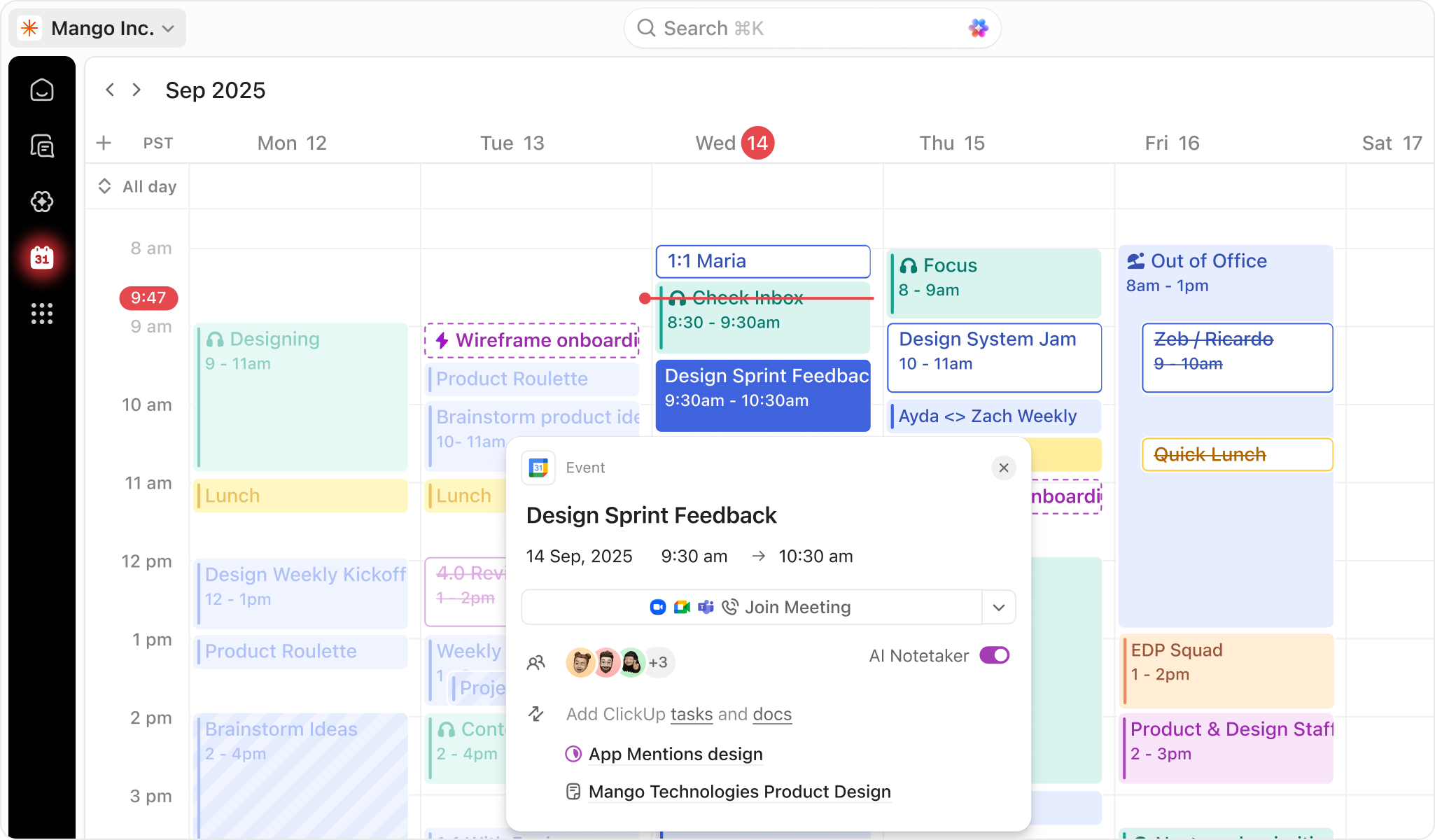
ClickUp is a productivity platform that brings together work apps, data, and workflows. Also presented as a Converged AI Workspace, ClickUp eliminates work sprawl to provide context and a single place for humans and agents to work together. The platform currently boasts over 20 million users worldwide.
$0
per month per seat
Miro
Score 9.1 out of 10
N/A
Miro empowers cross-functional teams to flow from early discovery through final delivery on a shared, AI-first canvas. With the canvas as the prompt, Miro’s AI capabilities keep teams in the flow of work, and scale shifts in ways of working.
$10
per month per user
Pricing
ClickUp
Miro
Editions & Modules
Unlimited
$10
per month per user
Business
$19
per month per user
Enterprise
Custom
1. Free - To discover what Miro can do. Always free
$0
2. Starter - Unlimited and private boards with essential features
$8
per month (billed annually) per user
3. Business - Scales collaboration with advanced features and security
$16
per month (billed annually) per user
4. Enterprise - For work across the entire organization, with support, security and control, to scale
contact sales
annual billing per user
Offerings
Pricing Offerings
ClickUp
Miro
Free Trial
Yes
Yes
Free/Freemium Version
Yes
Yes
Premium Consulting/Integration Services
Yes
No
Entry-level Setup Fee
No setup fee
Optional
Additional Details
Discount available for annual billing.
Monthly billing also available at $10 per month for the Starter plan, or $20 for the Business plan.
We actually liked monday.com it just was too expensive as you have to pay for every user - even if they only leave a comment every few months. Some promised integrations from monday.com just didn't probably work or have been extremely limited. All the promising automation …
Verified User
Employee
Chose ClickUp
The simple fact that ClickUp has everything integrated makes it very easy, no need to import information or update everything manually, is a one-stop shop and that’s the best part of ClickUp, The interface, which can be discovered and managed efficiently in a short time with a …
ClickUp is more complete than most of the other competitors on the list and is more focused on being awesome in providing the tools necessary for project management, including Agile methodologies, timetracking, and many more. For a software development company like mine, …
ClickUp is quickly moving up the ranks to surpass other project management software options that aren't readily available to whole teams. For the past two years, I've witnessed close competition between ClickUp and monday.com for the top spot as the foremost emerging project …
Throughout my career, I have used at least a dozen different project management platforms and tools for keeping projects moving along. While I have used project management tools from some impressive names, I found that most of them weren't very impressive at all. In so many …
Jira: More robust, feels like a dinosaur. It's a lot harder to configure; it's more stable, but it feels VERY painful to use for less tech-savvy developers. Artists HATED it with passion. Producers and scrum masters always like Jira better, but devs hated it. Clickup: Polished, …
From the above 2 applications ClickUp fared better because its free to use, has a design that stimulates task management and collaboration, but majorly our team liked using ClickUp instead of Notion or Asana. It is important that our team is comfortable using a software that's …
ClickUp is a lot more customizable, user friendly and comprehensive. While Trello might be a bit more minimalistic, i would choose a comprehensive tool over minimalism any day because it suits my needs specifically as opposed to a smaller org's needs. Trello has limited options …
We have compared different parameters such as usability, functionalities, cost, learning curve. And in the ended opted in for ClickUp due to a higher match with our requests.
The other tools are much more static in nature and not very use friendly when it comes to customisation. ClickUp offers a suite of customisation tools and Clickapps which help with whatever needs getting done in terms of forms,fields,etc. Therefore, ClickUp can be customised to …
When it comes to project management software, ClickUp and Asana are two popular options. After evaluating both, we selected ClickUp for our team's needs.In terms of features, the free version of ClickUp provides better features than the free version of Asana. ClickUp offers a …
With each of the other platforms I've used, there was no one-stop-shop. We always had to use outside platforms or add-on processes to supplement what was missing. Sure they had good enough features but good enough wasn't good enough. We are an innovative company that operates …
ClickUp literally came on the scene and in my mind instantly WON the project management game with the ease of use and flexibility delivered in the app. Best-in-class support and engineering a world-class experience is a massive piece of this and they continue to innovate every …
Jira was more expensive, but ClickUp competed directly with core functionality. However, in comparing them side by side, Jira felt to be more "mature." Meaning, Atlassian seems to know and anticipate use cases more thoroughly that ClickUp.
It offers a lot more; cut's down on the need to visit other websites. All the information is under a single website/desktop application. For example, Atlassian owns multiple software, but each is separate. ClickUp reduces the need to switch and sign into multiple …
ClickUp stacks up against others because it's a software much more complect than the other competitors, with more functions e usability. We selected ClickUp for a recommendation of one of the team players, and it really was an improvement for all of the company.
Fantastic, but it lacked on its free version the visualization I can have for free in ClickUp, meaning: I needed to work with deadlines and dates and ClickUp gave me the chance with all the features I needed, that's why I left it in main.
I very much prefer Miro over the ClickUp whiteboard tool. It is easy to use, and in ClickUp, I spend so much time just trying to format individual nodes.
I have not used anything like Miro, only Power Point, which is the only one that is similar. There is a tool like Miro within ClickUp, but it is not as intuitive and easy to use as Miro.
ClickUp is our go to project management system that also has in-build whiteboards. But they do not work as fast and seamless as Miro. So we still use miro for that part and ClickUp as project management system. We also believe that if every SaaS focusses on there own super …
We assessed these tools to gain a better understanding because they are excellent and have certain unique features. But in the end, we chose Miro since it offers all the features that ClickUp, Stormboard, and Conceptboard do. Additionally, it has a special feature that lets you …
click up is known for its visual product, project management and collaboration features it integrates task projects and communication all in one platform but overall I think Miro is a more efficient tool plus more and Mural is ideal for visual collaboration and creative …
Miro is a whiteboarding tool for real time collaboration and workshops, while TheyDo is only specifically meant for journey management practices and use of automated performance metrics integrated into TheyDo helps to visualize the upward and downward trends. TheyDo also helps …
The issue of flexibility was what impacted me most in my decision to choose Miro. The Miro whiteboard has been very useful in my routine, I can enter all the tasks I need to carry out, all the schedule and it is easy to view.
I only had experience with LucidChart before Miro but the interface was not flexible enough to allow me to do everything that I can do with Miro. The interface was also not as friendly or intuitive.
We generally found cross-functional collaboration and client input to be easier within Miro than with Figma. This related somewhat to the ability ti invite "guests" into the space to participate, and its ease-of-use in-browser.
Milanote doesn't offer the mind map functionality and is so rigid. Microsoft Visio is overpriced, does not have a collaborative feature, and was very clunky. Adobe PhotoShop is a great artistic tool, but it is not easy to use for brainstorming. I tried.
Much better for collaboration and ideation than any of the others. Mural has a few superior presentation features (last time I used it a long time ago) and Notion is perhaps easier for business stakeholders to get their heads around, but miro comes out on top for me.
We decided to go with Miro (even having visio installed as part of our microsoft suite) due to the easy-to-use environment and user friendly UX/UI, the was it easier than any other tool to share content, boards or anything it's simply a win-win situation for us, no matter your …
There are certain things that Miro can do that these other platforms simply cannot. Bottom line. Miro is the most elite visualization software for program and product management. While other products offer Miro-like services or features, they do not measure up. Miro has the …
Great for project management, reoccurring task management, building trackers and keeping track of what everyone is up to. Like all software that has great functionality, having solid governance and control over access is essential. I recommend ensuring that your admins/owners have a close eye on what is going on across the space or it can turn into an unmanageable nightmare.
For me, Miro works best for messy internal processes. One of the instances include there are updates in math guidelines or reorganizing how topics should flow. I can put everything on the board, drag things around, color code it, and suddenly everything actually makes sense. It's also a common interacting space for the team to think out loud. Keeps everyone aligned without different documents floating around. It has a downside too. When the board gets big and full of screenshots or reference files, it slows down and I have to wait for things for so long.
Sticky notes cannot be easily resized. It would often be useful for them to transform into workspaces, because they become actual text content rather than just notes.
Perhaps there is no option to sort the work boards according to specific criteria (such as alphabetical order or date).
The various functions available should perhaps be explained clearly with a tooltip or something similar while you are working with the various tools. I often don't realise that certain things can be done.
It has been a game-changer in terms of project tracking, as animation is a demanding product that requires multiple layers of analysis, revisions, tracking, scheduling, etc. ClickUp simplifies many approvals as anyone can easily add items, and you can tag the people who need to look at them.
I have advocate for the renew of Miro quite few times, however, it is not under my control as the decision is made in another team with their own budget. I would buy for my own entrepreneur projects (1-2 members) as I do know the value and work there 100%. So, I would pay out of my own pocket to get the value. However, If I wouldn't know the value it provides, it would be hard to decide with the current freemium features
Far easier to use than any other PM tool. ClickUp is incredibly intuitive and had us saving time and energy within the first week of implementation. In my opinion, PM software should make it easier to focus on the deliverables - it shouldn't take all your time and energy to learn how to use the tool in the first place. ClickUp is a user-friendly tool that actually helps us focus on what's important.
Solid usability, we transitioned from Mural, so some of it is a learning curve from what we were used to in the prior tool. As previously mentioned, the scrolling feature and moving around the board is not as intuitive as I would like. Outside of that, the functionality seems to mee the expectations we have for a collaboration tool
For over a year ClickUp was unavailable to us just twice for a couple of hours. I would say for a system this big and working globally that was a minor issue. They managed to fix all the issues within a couple hours and then it was back up and running perfectly fine.
I only give a 9/10 because of the speed at which it loads. I have never experienced issues with Miro logging me out early, or some other technical issue causing the program to crash, or even it just loading in perpetuity without ever actually coming up (unlike other programs such as SFDC). It take a minute for all of my boards to come up after I click on it in my favorites, but besides that, it's all good.
The speed of ClickUp is average to be honest. This is one of the biggest flaws of the system, sometimes it's also lagging a little bit but we also have a lot of documents, lists etc. on our workspace. However, with the next version of ClickUp I've seen they are planning to increase the speed by almost 500%, probably by changing the technology, so I am more than looking forward to it.
Sometimes it gets quite slow and there is a correlation between this and the size of the board. Hence we are trying to segment the boards based on product stages or projects so that the size doesn't go big. When you go from discovery to delivery on a simple board, it will get large and difficult to load, even crash or go white screen
I started using ClickUp when it was what most would consider a baby company. There were the occasional bugs that made working in ClickUp a little bit of a headache, but the support feature allowed me to chat with a real persona and communicate my issues. I would always get prompt support and someone willing to really help me, not just point me to FAQ pages. Not feeling like a number really makes a difference.
We have never reached out to or contacted support because Miro's platform has been incredibly intuitive and user-friendly. The comprehensive resources available, such as tutorials, documentation, and community forums, have provided all the guidance we needed. The seamless integration with our existing tools and the reliability of the platform have ensured that we rarely encounter issues that require external assistance. This self-sufficiency has allowed us to focus more on our projects and collaboration without interruptions. Overall, our experience with Miro has been smooth and efficient, eliminating the need for additional support
There are multiple guides on literally all of the functions you can find within the system, therefore it's easy to learn anything you'd really like to use, starting from project and people management, down to Gantts, mind maps, time tracking, inviting Clients as guests to work with you on the projects and so much more.
There was a series of webinars which Miro hosted with our organization that went over the basics, then progressively became more advanced with additional sections. The instructors were knowledgeable, and provided examples throughout the sessions, as well as answered peoples' questions. There was ample time and experience on the calls to cover a range of topics. The instructors were also very friendly and sociable, as well as honest. Of course Miro isn't a "God-tool" that does absolutely everything, but the instructors were aware and emphasized the strengths where Miro had them and sincerely accepted feedback.
Start small. Don’t try to build the most elaborate plans first. Resist the urge to get into Gantt charts if no one is used to them. Just get work written, add dates and assignees, and start getting used to it. If you did not use a work management tool before, you need to be gracious with yourself about the fact that you likely do not have the muscle memory for working this way yet. But you will get there.
And leverage people who know it if possible. Look for ClickUp experts and vendors. They can really supercharge your effectiveness at building the tool out and speed up the process.
Easy to learn, Miro has a series of videos on YouTube that effectively taught this program to my team members and me. The program is drag-and-drop and works excellently. People pick up on how to use it efficiently, and it's great for organizing ideas more freely. This product is more challenging for some older audiences who are not accustomed to using a touchpad, but for most, it was very easy to use.
I did not make the decision to move to ClickUp, but I did provide feedback and hear feedback from our internal team about how ClickUp centralizes a lot of the company wides resources into one space. I feel that ClickUp provides more dynamic workflow building beyond Jira and Karbon, and tasks and questions are more searchable cross team, causing more time saved and less time reaching out to ask for an update. All Apps have their individual strengths, but ClickUp has it all live together in one space, making it easier overall for searching and updating items internally as a team.
While not as feature rich to be honest as some of these focused tools, it still replaces a vast majority of them. It is enough to make it easily replace the listed tools if you wish to do so. This not only saves time pivoting between tools, but also money with licensing which is an easy sell to my management.
Scaling with ClickUp is superb. If you create a workflow best suited for your organization then it's all about creating new accounts and teaching the new employees the workflow you're using. It's that simple. There is no black magic when it comes to Clickup.
Maybe is possible now so... Could be useful to manage in some way source code for the projects? not to edit so when we make solutions with different components in MIro, maybe each component could redirect to the source code of this component
Before ClickUp, my team would have multiple different project trackers, all in different locations, formatted in different ways. ClickUp has allowed us to move all those trackers into one location with a specified template and the ability to directly link tasks to tickets. This has greatly impacted project deliveries in a very positive way.
The time tracking feature of ClickUp has been amazing for our development team. Instead of them having to track in a separate document or at the end of every day, try to remember what they worked on and when, they instead can just hit a timer button on the ticket and go off to work. This alone has saved time and improved the accuracy of tracked time to projects.
We did a dynamic activity based on actionable insights from a research study that I conducted. It was great to see people interacting, and one of the proposals was successful, resulting in a 6 million (in local currency) contribution to the company!