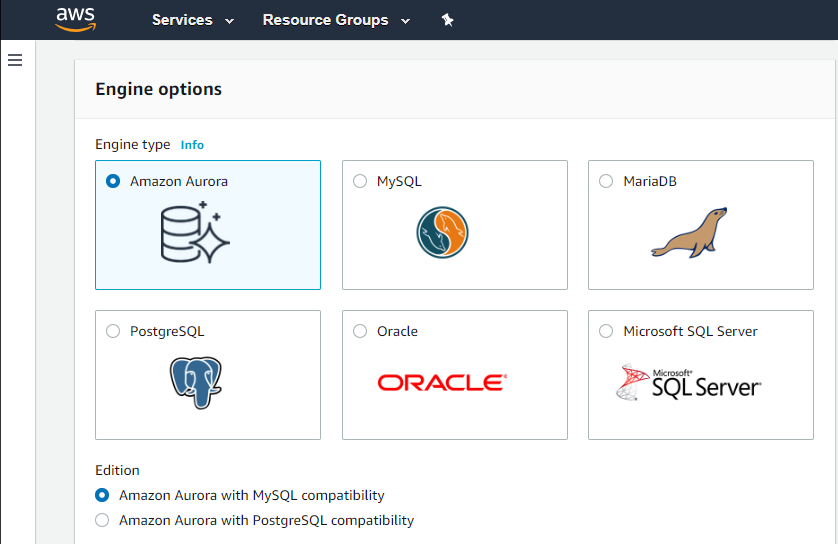
Amazon Relational Database Service (Amazon RDS) is a database-as-a-service (DBaaS) from Amazon Web Services.
N/A
EDB Postgres Advanced Server
Score 10.0 out of 10
N/A
The EDB Postgres Advanced Server is an advanced deployment of the PostgreSQL relational database with greater features and Oracle compatibility, from EnterpriseDB headquartered in Bedford, Massachusetts.
If your application needs a relational data store and uses other AWS services, AWS RDS is a no-brainer. It offers all the traditional database features, makes it a snap to set up, creates cross-region replication, has advanced security, built-in monitoring, and much more at a very good price. You can also set up streaming to a data lake using various other AWS services on your RDS.
It's great if you are using or wish to use PostgreSQL and need the added performance optimization, security features and developer and DBA tools. If you need compatibility with Oracle it's a must-have. There are many developer features that greatly assist dev teams in integrating and implementing complex middleware. It's great for optimizing complex database queries as well as for scaling. I would recommend Postgres Plus Advanced Server for any software development team that is hitting the limit of what PostgreSQL is capable of and wants to improve performance, security, and gain extra developer tools.
Automated Database Management: We use it for streamlining routine tasks like software patching and database backups.
Scalability on Demand: we use it to handle traffic spikes, scaling both vertically and horizontally.
Database Engine Compatibility: It works amazingly with multiple database engines used by different departments within our organization including MySQL, PostgreSQL, SQL Server, and Oracle.
Monitoring: It covers our extensive monitoring and logging, and also has great compatibility with Amazon CloudWatch
PPAS Oracle compatibility, especially the PL/SQL syntax, has made migrating database-tier code very simple. Most Oracle packages do not need to be changed at all and those that do are generally for simple reasons like a reserved word in PPAS that is allowed in Oracle.
PPAS xDB, the multi-master replication tool, is simple and - most important - does not break with network or other interruptions. We have been able to configure and forget, which our customers could never do with other multi-master tools.
Most people had no idea that PPAS and PostgreSQL have full CRUD support for JSON. They think you need a specialized product and/or that JSON is read-only. Every organization that I have worked with is evaluating adding JSON to their relational model.
It is a little difficult to configure and connect to an RDS instance. The integration with ECS can be made more seamless.
Exploring features within RDS is not very easy and intuitive. Either a human friendly documentation should be added or the User Interface be made intuitive so that people can explore and find features on their own.
There should be tools to analyze cost and minimize it according to the usage.
Documentation is excellent but spread out across many resources and can take a while to wade through—would benefit from having more intro level, getting started guides for various languages.
Ruby support is excellent but more Ruby examples and beginner-level documentation would be nice.
It is sometimes hard to find a community of users on StackOverflow so a larger community, and a dedicated forum with active members to answer questions and work through issues would be nice.
We do renew our use of Amazon Relational Database Service. We don't have any problems faced with RDS in place. RDS has taken away lot of overhead of hosting database, managing the database and keeping a team just to manage database. Even the backup, security and recovery another overhead that has been taken away by RDS. So, we will keep on using RDS.
I've been using AWS Relational Database Services in several projects in different environments and from the AWS products, maybe this one together to EC2 are my favourite. They deliver what they promise. Reliable, fast, easy and with a fair price (in comparison to commercial products which have obscure license agreements).
I have only had good experiences in working with AWS support. I will admit that my experience comes from the benefit of having a premium tier of support but even working with free-tier accounts I have not had problems getting help with AWS products when needed. And most often, the docs do a pretty good job of explaining how to operate a service so a quick spin through the docs has been useful in solving problems.
Amazon Relational Database Service (RDS) stands out among similar products due to its seamless integration with other AWS services, automated backups, and multi-AZ deployments for high availability. Its support for various database engines, such as MySQL, PostgreSQL, and Oracle, provides flexibility. Additionally, RDS offers managed security features, including encryption and IAM integration, enhancing data protection. The pay-as-you-go pricing model makes it cost-effective. Overall, Amazon RDS excels in ease of use, scalability, and a comprehensive feature set, making it a top choice for organizations seeking a reliable and scalable managed relational database service in the cloud.
PPAS proved better for our customer's data-centric apps than Oracle in all but a few edge cases (encryption at rest and multi-TB database-tier backups) because it is simpler to install/maintain, runs nearly all Oracle-syntax SQL as well as ANSI SQL. PPAS has much more JSON capabilities (full CRUD vs. read-only in Oracle), simpler geospatial, simpler / more stable replication and datatypes that match developer expectations, such as BOOLEAN and ENUMs.
Postgres Plus Advanced Server is quite complex and may take longer to implement certain things than simply using PostgreSQL depending on developer familiarity with the platform.
Getting up to speed can be daunting so again, there is an upfront cost in time spent learning the platform, besides the potential for extra time spent on a feature-by-feature basis.
The cost of Postgres Plus Advanced Server should be weighed against simply using PostgreSQL to decide which is the best solution for your business needs.